

ESPCs for Rooftop Solar
By Caitlin Marshall, PCAT
Sometimes, the big, exciting ideas take a lot of nitty gritty details to get done.
Solar panels on schools have long been a dream in Portland. Students, teachers, advocates at Portland Climate Action Team (PCAT), and many other Portlanders want solar on schools. Public schools are big buildings with big roofs, and since they rely on taxpayer funding, it’s good news for all of us when they can save on costs. These make them an excellent candidate for solar arrays.
Energy Savings Performance Contracts (ESPCs)
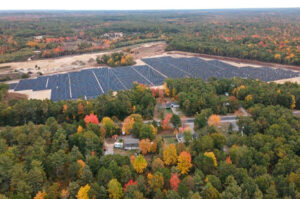
So, great idea! How do we make it happen? Time to dive into the details. Like any major capital improvement, installing a large solar array takes a large amount of money. Even though it will save a lot of money in the long run, it is hard to come up with the cash in the short run.
This is where Energy Savings Performance Contracts, or ESPCs, come in. This is a set structure that pays for the cost of the project, over time, out of the savings generated in the future. As a very basic example, let’s say a monthly heating bill has been $100. With new insulation installed, that will go down to $60. The $40 difference is put toward paying off the new insulation — and once it’s paid off, that $40 is pure savings.
We use ESPCs for energy saving projects of all kinds, from insulation upgrades to water conservation measures – and solar. Municipal, state, and federal governments use them, as well as universities, schools, and hospitals. Under an ESPC contract, savings are guaranteed. This ensures stability for institutional budgets that should not take on risk.
Solar for Portland Schools
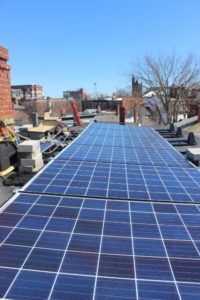
Right now, PCAT, the Portland High School Environmental Club, and others are advocating for an ESPC to put solar on Portland public schools. Westbrook has already committed to putting solar panels on the rooftops of four of its schools.
We can look to New York for other examples. In 2024, the Eastport-South Manor school district completed an energy efficiency project that included solar, LED lighting, and HVAC improvements, using the ESPC structure (1). The $18.5 Million project has projected annual savings of $993,000 with a 63% reduction in energy use. Indeed, PV Magazine notes K-12 schools in particular make up one of the largest markets for ESPCs.” (2)
It’s a lot of acronyms; it’s a lot of meetings – but it all adds up to making real progress toward climate resilience in our town.
Bright Ideas is brought to you by PCAT, which meets the fourth Tuesday of the month, 6 to 7:30 p.m. All are welcome. FMI: email Portlandclimate@gmail.com or visit http://facebook.com/PortlandClimateActionTeam.







One Comment
Pingback: Revisit Project Drawdown - Scoring climate solutions for the biggest impact - The West End News