We’re All in This Together
First International Conference Transitioning Away from Fossil Fuels
By Dr. Susana Hancock
I love sharks. As a cryosphere scientist, I’m rarely in the water with sharks. When I am, however, it’s exciting. As a scientist in the UN climate negotiations, it’s also exciting when global discussions are altruistic and productive. Last April, I had two very exciting weeks.
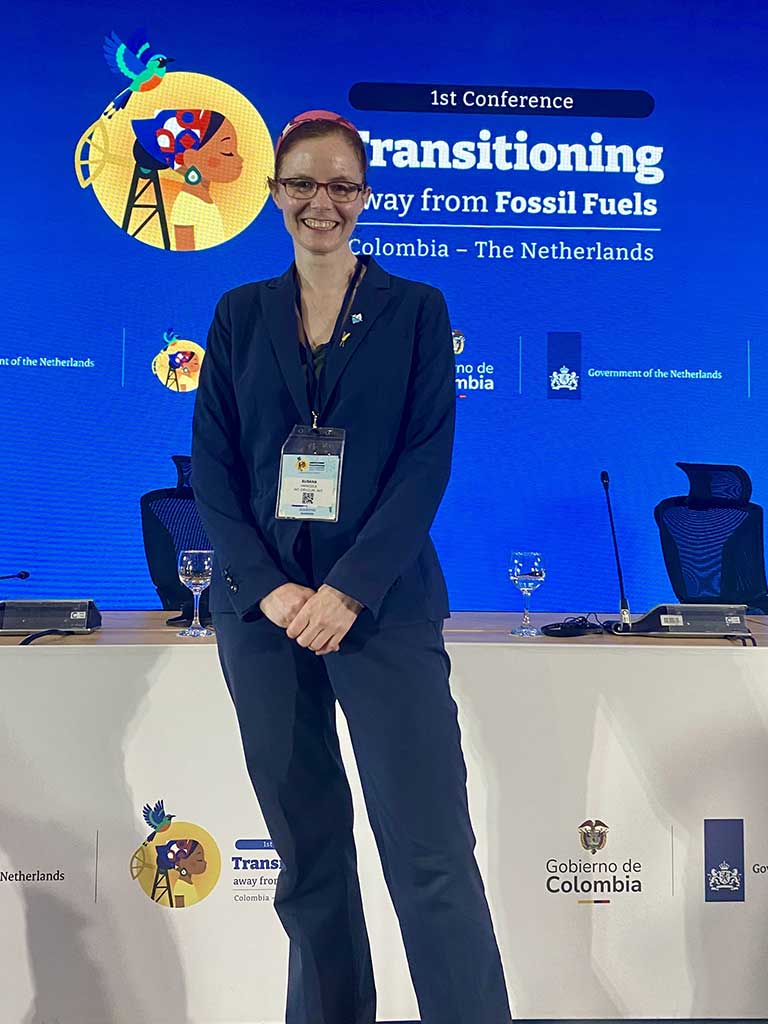
The First International Conference Transitioning Away from Fossil Fuels in Santa Marta, Colombia, however, wasn’t a typical climate negotiation. This wasn’t just because I spent my sunrises wearing fins and a mask while dolphining my body beneath the waves of the northern Colombian coast hoping to catch a glimpse of the local shark species.
These meetings, born out of the better-known annual UN COP process, comprised 57 countries and the European Union. It was a so-called coalition of the doers. Delegates didn’t sit around large square tables but instead in small circles. There was no word-jousting, just listening.
Critically, there were no petrostates or fossil fuel lobbyists. Afterall, why invite mosquitoes to a conference on the eradication of malaria? In some ways, the only similarities between the Santa Marta Conference and the UNFCCC negotiations involved armed guards and bets placed on the length of delay for the closing plenary.
I had been loosely engaged in the Santa Marta process since the inception.
In January, I was a scientist for an expedition climbing the remaining tropical glaciers of the high Colombian Andes. Afterward, I spent time in Bogotá where I met with the environment and foreign ministries to discuss the importance of the dwindling glaciers for Colombia’s water and food security. Given that 1.5 degrees Celsius, the lower limit of the Paris Agreement, is already too high for the planet’s frozen regions, I framed ice loss as a driver of urgency and ambition for getting off fossil fuels.
In Santa Marta, I had roles in various sectors’ pre-meetings. For example, I was part of the science chapter shaping roadmaps to get off fossil fuels. My final days were spent post-dawn with sharks, of course, as a science-policy expert in the high-level sessions with global climate ministers and other international delegates.
By the time this hits newsstands, I will be in Europe. I’ll once again be sitting around large square tables in consensus-based negotiations. Don’t get me wrong: the UNFCCC has a purpose. However, as the climate crisis deepens and adaptation limits are being pushed, new avenues are very much necessary and they are exciting.
The sharks – and all other species of the Holocene – are counting on us!
Dr Susana Hancock is a glaciologist and international climate policy specialist. She is a volunteer for the nonpartisan Citizens’ Climate Lobby.