Book Short
The Orphan Master’s Son
By Adam Johnson
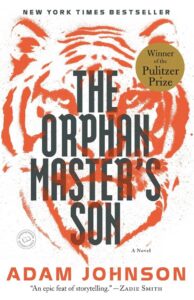
Aug. 2012 / 480 pp.
Paperback
By Stephanie Miller
The back cover blurbs declare this novel of life in North Korea “addictive,” “of daring ingenuity,” and “rendered with the soul of a native” – a “masterpiece” and “literary tour de force.” It is certainly really good, but it is also hard to read such an unflinching tale of the cruelty, physical torture, and psychological control of citizens under an authoritative regime. I am not sure I enjoyed the experience, but the well-constructed characters and rapid, complex plot is incredibly compelling.
“The Orphan Master’s Son” tracks the life of Pak Jun Do, whose mother is “stolen” to Pyongyang and father runs the Long Tomorrows work camp for orphans. This is where Jun Do lives, as an inmate but with the small power to assign work duties. His loyalty and quiet strength come to the attention of authorities who conscript him into a kidnapping scheme.
From there, he must continually strive for survival amid the shifting rules, arbitrary and cruel violence, and baffling demands of his overlords. His good work is rewarded by a stint in “pain training” where he learns to survive torture, and enrollment in Language School where he learns English. That leads to further adventures including being a radio operator/spy on a fishing boat and a state visit to a US Senator’s ranch in Texas.
Jun Do is wise enough to see what is happening in his country.
Yet, he chooses to continue on the path he is assigned. He reflects, “There was intention, significance, and purpose in what people did [in this country] – he needed to believe this. Normal people, he understood, had no need for such thinking.”
Despite many chances to defect, he stays aligned to the regime, until he takes on an impossible and dangerous role of defying the Dear Leader himself to protect and save the woman he loves.
Talk about a character who has to continually watch his back! The novel unspools in an asymmetrical order, alternating viewpoints, timelines, and motivations until the reader is just as unsure of the real plot as the citizens.
One of the character voices is the always-on state propaganda radio station, which blares into every home and worksite fifteen hours a day. With this, author Adam Johnson weaves the story of Jun Do and his struggle to survive into the national narrative… What is true? What is truth? Who are you?
Micro Shorts
“Kate Meader”
By Deborah Gould (Maine Author)
Based on real residents of Gardiner, Maine, at the turn of the 19th Century, historical author Deborah Gould weaves real clippings from the local newspaper into this story of the title character, a widow, employed as a cook at the Almshouse.
The Horse Notes column includes, “Bert Yeaton is driving a handsome pair of brown horses.”
The Localets that week included, “The Clothing Club has suspended work for the season. This is a hopeful sign of the times, for it proves men are at work earning sufficient wages to feed and clothe their families, and not dependent on outside aid.”
Kate herself is a similar mix of practicality and industry. Still, she has room in her heart for compassion and joy. The steady, quotidian beat of this story captured me on the first page and I finished it in one sitting. I then picked it up again the next day and read it again.
“The Author Weekend”
By Laura Zigman
I got to chat with Laura Zigman at her Print: A Bookstore reading. It was such a lively and interesting conversation that I can almost see why people would pay high fees to attend an author weekend in some exciting locale with other fans to get some quality time with a favorite author.
In this mystery cum satire on the publishing industry, Zigman’s comeback novel a decade after her best-selling “Animal Husbandry” was made into a movie (“Someone Like You” with Hugh Jackman), her protagonist author goes to incredible and dangerous lengths to ensure that her first author weekend doesn’t derail her carefully constructed career.
Expect murder and betrayal and some delightful passive-aggressive manipulation. It is all framed in parody of what has become a corporate and soulless editor-eat-author-eat-agent world of publishing. It’s a fast-moving, clever, and dark portrayal told in alternating voices. Telling you more would spoil the story.
“Wild Dark Shore”
By Charlotte McConaghy
A woman searching for her researcher husband washes up on the storm-battered shore of a subantarctic island. She is rescued by a family of caretakers who claim her husband and his colleagues already left the island. The communications tower is smashed. The global seed bank that gives the island its purpose is slowly sinking beneath the waves. Even worse, a rescue ship is not scheduled to arrive for nearly two months.
Everyone is hiding something. Despite welcoming the woman into the family, no one really trusts anyone else. This part-mystery part-ecological warning call slowly rolls out, and each person needs to face their part in the unraveling, as well as claim the love they deserve.
While the characters struggle with these micro-dramas, they must make a huge macro decision for humanity. Only half the seeds can be saved. The mandate was to save only the seeds of plants that humans eat. But the family knows that biodiversity is essential to the planet’s survival, and many decorative or poisonous plants, even “weeds,” are important to the future.
Loosely based on life at the Macquarie Island Research Station jointly owned by Tasmania and Australia, the island itself — its flora, fauna, and undersea forests — is a character in the story. In fact, the island drives much of the storyline through its demanding cold, storms, and topography.
It’s a terrific and well-conceived drama and an unsentimental look at the impact of climate change.
“Isola”
By Allegra Goodman
This is the fictionalization of the life of Marguerite de la Rocque de Roberval, a sixteenth century noblewoman, who accompanied her cousin Jean-Francios Roberval on his voyage to New France (Canada) in 1542. Two wildly different contemporary accounts survive of her voyage and subsequent abandonment on a small island.
With just a few snippets to work with, award-winning author Allegra Goodman creates a harrowing tale of resilience and survival, complete with the psychological and social abuse common for women of the time. With no rights and no direct access to financial security, noblewomen played politics for power. Marguerite is a baby when her cousin Roberval is appointed her guardian. He plays dirty, and so she learns quickly. As such, we might interpret her impetuousness as bravery.
It’s a softly flowing, sensitive interpretation of what could have happened – and maybe did!