Book Short
‘Winter in Madrid’
By C.J. Sansom
By Stephanie Miller
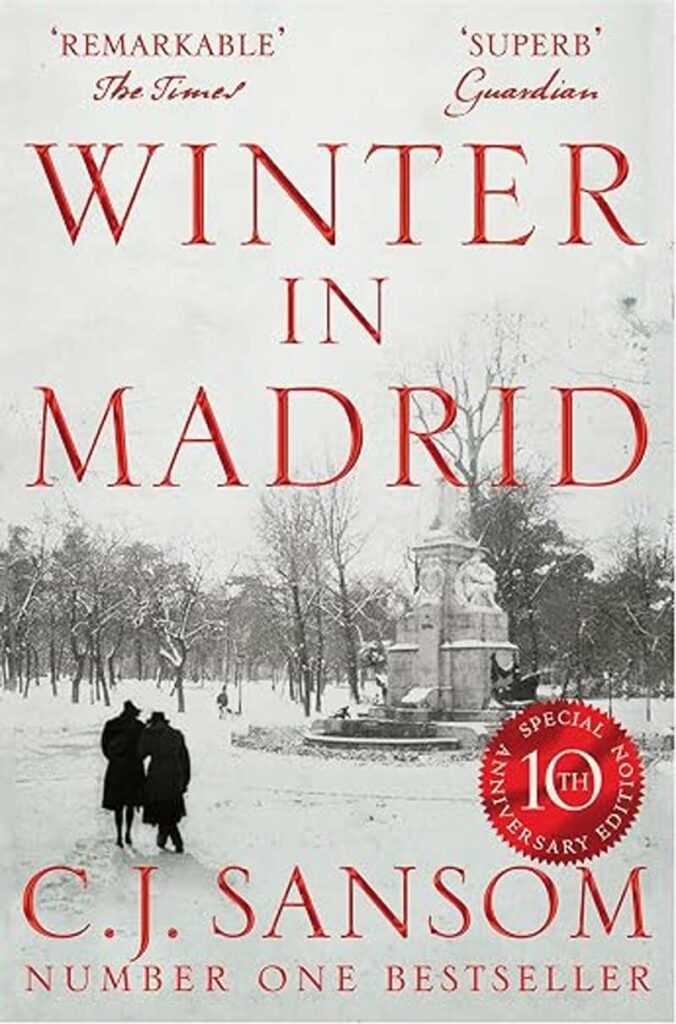
By C.J. Sansom
Penguin Books | 2009
544 pp. | Paperback
Three British public-school roommates meet up years later in Madrid as the Spanish Civil War closes and the city lies in ruins. The city’s people are starving and bone-weary, but still actively patriotic. Bernie, a devout Communist, arrived years ago to fight on the side of the working people. Sandy, proudly embracing his reputation as a “bad hat,” is selling a dangerous but fabulously lucrative business deal to General Franco, himself playing a dangerous game of cat and mouse between Hitler and the British for foreign investment in his broken country. And then there is Harry. A solidly bourgeois middle class professor and wounded Dunkirk survivor turned very reluctant spy.
Bernie, officially declared killed in action, is languishing as a prisoner of war in a brutal camp led by a sadistic director. Barbara, his grieving lover, has fallen under the control of Sandy, who enjoys the irony of being with the ex-girlfriend of his old school nemesis. Harry is summoned from his convalescence to a meeting in London. The fledgling M16 has discovered that he knows Sandy, and they are eager to find out what the shady businessman is plotting. Harry, under a cover as an embassy translator, arrives in Madrid, “just so happens” to run into Sandy, is surprised to discover Barbara is living with him in a sham marriage, and clumsily tries to gain everyone’s confidence, including that of his London handlers. Meanwhile, Barbara is planning a secret mission all her own. Let the intrigue begin!
This international best-selling thriller is also a wonderful historical portrait of how Spain was a pawn in Hitler’s game to take over Europe and how Franco made the best of a weak hand to leverage as much foreign investment as possible. The British Navy was blockading the ports, controlling supply access. The Russians had been active on both sides of the civil war and still had tentacles throughout Spain agitating for communism and workers’ rights. This era in Spain’s history is fraught with fractional tension, and some stakeholders seem to change sides a few times. While this fictional account features many of the actual men pulling strings at the time, it does not attempt to give us a history lesson.
What is here, though, is how the political pressures translated to food and heating shortages and a depleted economy. There is a great sense of place, as the suffering and cold Madrid of that time becomes visible. If you have ever been to Madrid — and I read this while I was in the city — you will recognize the plazas and landmarks and food. The story is about ordinary Madrilenos — and three British men of wildly different perspectives operating under wildly different moral codes — all faced with impossible choices.
Micro Shorts
“You Never Forget Your First: A Biography of George Washington”
By Alexis Coe
Myth busting never had so much fun as in this erudite but cheeky biography of our nation’s first president. Biographer Alexis Coe takes a different approach from her male predecessors whom she calls the “Thigh Men” for their heady fascination with Washington’s physical strength. Although using the same sources as everyone else, she brings a less awed and more nuanced view. The result is a very approachable, fun, comparatively slim, and fascinating look at the man and how he influenced and was influenced by the politics and norms of the time.
Throughout, she dispels myths like the wooden teeth—the truth is even more gruesome. His dentures were made from horns of exotic and domestic beasts and even teeth from his own slaves. She lists some of the juiciest of Washington’s snarky marginalia in his copy of James Monroe’s widely published self-defense of his recall as Ambassador to France by Washington himself.
Washington was very active in animal husbandry and is also known as the Father of the American Mule. He was begged twice to serve as our President. But after eight years of trying and mostly failing to manage his unruly and ideologically diverse cabinet — and even after replacing most of his fellow Founding Fathers in his second term — no one asked him to run again. He and loyal Martha returned home to their beloved Mt. Vernon. He got to live only another two years doing what he loved most, including riding out before dawn to visit all his farms and remonstrating those caretakers who were still sleeping.
I learned a lot about his earnest and legitimately successful efforts to create a new nation. (I mean, his accomplishments in nation-building are darn impressive, right?!) Not to mention his stoic, industrious character. His values and traits live on in our collective embrace of entrepreneurial capitalism and a quest for common good. This is a very accessible and lively biography.
“It Will Come Back to You”
(Stories) by Sigurd Nunez
This collection was recently published to feature stories created over a long writing career, including nine novels translated into 35 languages. They are consistently spry, inventive, and do what short stories do best: use a moment in time to illuminate a character.
The opening lines are universally brilliant and, as they should, draw us in:
“What I want to know,” the woman said to the therapist, “Is why the voices always say mean, terrible things. Why do they never say, ‘You are a good person!’?
My brother calls like he always does after visiting our mother at Villa New Beginnings.
Our sister has always caused us grief.
There is a blend of mystical soul searching and the very prosaic ordinariness of lives in each story, grounding the characters in the kind of quotidian moments that touch us fleetingly, and, of course, make for good storytelling. The language is spare and gorgeous. One story ends:
“Carmine had never heard a harp live before, but she immediately recognized the tear-jerking song. Through a blur, she sees Celina, raptly whisper-singing ‘What a wonderful world.’ And it was as if she were seeing three faces – her granddaughter, her guardian angel, and her young mother – all magically superimposed. Oh yes. It was a funny, wonderful world. At the other tables, people kept talking and eating as if nothing miraculous was taking place, and when the music stopped, only Carmine and Celina applauded. Then they finished their tea: every sandwich, every scone, every piece of cake.”
“The Predicament”
(A Gabriel Dax Novel), by William Boyd
In this second of his writer-turned reluctant spy Gabriel Dax novels (the third, “Cold Sunset,” is just out), prolific novelist and nonfiction author William Boyd tells a fast paced espionage thriller that is a story within a story within a story that each include a mirrored repetition of classic lone gunman strategy of creating anarchy. When charismatic young President Kennedy arrives in West Berlin, the stakes get even higher.
There are a lot of politics and a deepening sense of foreboding that permeate throughout as Dax tries to figure out who is on what side and if he can trust anyone — even his own semi-feral cat. This is my first thriller by Boyd, being familiar only with “Any Human Heart” (which I was inspired to re-read) and some of his stories.
I enjoyed it and will dig up the first in the series to catch up.
“Any Human Heart“
By William Boyd
In this intimate diary of Logan Mountstuart, we follow his story from Oxford (women, wine, reckless adventures undertaken as dares with friends) to early career (slacking, women and a wife, wine) to the war years (reluctant spy, women, wine, prison) to grief-filled art gallerist career in NYC (seeming success, women, wine, dubious moneymaking schemes) to retirement (gentile poverty, women, reuniting with school friends, move to France).
He lives a privileged and selfish life and yet his caustic observations and abundant self-centeredness (what is a diary for, after all?!) are compelling and layered with imaginative detail. Mountstuart is a writer by trade, so in his diary we are treated to a writer’s vivid, detailed curiosity of place, nuance, and character.
As Boyd’s 2002 “masterpiece,” I re-read it to recall his style after reading one of the author’s later crime fiction books (reviewed above). I can see how his later Garbriel Dax detective (also a writer) builds from this book’s form and narrative omniscience.
“The Midnight Feast“
By Lucy Foley
Since Lucy Foley was selected by the Agatha Christie estate to write a new Miss Marple mystery (stay tuned for a review – it’s on my stack!), I wanted to read something by her in advance. And yes, I wanted to judge for myself if she’s worthy to carry on the torch from my beloved Agatha.
I started by reading her “Last Letter from Istanbul” and found it rather vanilla although it is told by a charming set of character voices and has a good (if somewhat predictable) twist at the end. “The Midnight Feast,” however, was amazing.
It’s a murder mystery told in alternating voices where the spoiled, privileged, manipulative, and frankly rather diabolical Francesca uses her family money and personal charm to warp the world around her selfish aims. Thankfully, through a pretty clever set of counter manipulations by the locals who detest how Francesca is literally bulldozing her way through their public lands, she gets her well deserved cumuppance. Here, almost no one is who they seem to be and lots of spooky things happen in those woods! I was hooked from the first chapter.
“Everything is Beautiful and Nothing Hurt“
By Ben Reeves
This is a strangely mystical and engaging portrait of a hundred lives – happy, sad, long, short, too long, too short — through the lens of Death, who is both everywhere at every moment and found slouching along in the person of a non-descript, slightly grungy, 30-year-old man named Travis.
When he is not offering people comfort in their final hours, he restores old photographs — a wry side hustle for someone in his profession. Each brief chapter is another encounter of Death/Travis meeting people at their best or worst at the last moments of their lives.
Reeves manages to make each chapter and each quotidian life fascinating, and we become not just voyeurs at those final, evaporating, precious moments, we begin to see all the things that make life worth living. The chapters are so brief, it’s like looking at a room full of mirrors.
The same thing starts to happen to Travis himself. Despite the distance he tries to create, he finds himself drawn into the lives of his neighbor Dalia, a midwife, and her precocious eight-year-old daughter Layla. The last chapter is a wonderful call to action that reminds us to live like today is our last day.
“Black Elephant“
By Virginia Frances Voight
Hathaway’s Rolling Show arrives in Western Maine in July of 1851 and teen-aged elephant trainer Dilly is thrilled when Ebony, a young black bull newly arrived at the circus, is assigned to his special care. When Ebony is abused by a cruel trainer and bolts, Dilly abandons his post to track him before he is destroyed by the local authorities.
This adventure was written in 1959 and is very much of the era of wholesome children’s books. Dilly’s quest, and the friendships made along the way, show how he earns both Ebony’s trust and respect and proves to his circus family that he’s worthy of his job.
Since I love elephants and this is packed with wonderful Maine scenery, I enjoyed it heartily and cheered at the end. If you can find it in a well-stocked used book barn somewhere, grab it!
“Wishin’ and Hopin’”
By Wally Lamb
Ten-year-old Felix is just trying to get through fifth grade at Aloysius Gonzaga Parochial School in 1964. One thing on his mind is figuring out the birds and the bees beyond the few hints from “the talk” with his father, limited to not drinking from public water fountains, and incomprehensible jokes from his best friend Lenny.
This is a wonderful boy-comes-of-age story reminiscent of holiday TV specials and complete with the inevitable, disaster-prone Christmas Pageant. Felix is both innocent and mischievous and remains a very good sport when the joke is on him. His inner dialogue narrating the story is hilariously charming.
This 2009 short novel from the author of “She’s Come Undone” and “I Know this Much is True” will make a wonderful holiday gift for anyone who was taught by nuns — and/or has a sense of humor!