
By Nancy Dorrans
While I had never been to Peru before, I knew there was more to discover beyond Machu Picchu. This is why I applied to attend the Adventure Travel Trade Association (ATTA) Adventure Elevate Latin America event in Peru in June. I knew this event would offer me the first-hand experience I needed to learn and share more of Peru with all of you. And I was not disappointed.
I departed for South America on Election Night, June 9th to arrive in Peru very early the next morning. Going on very little sleep I was warmly greeted by my hosts from Prom Peru. Winding through Lima’s chaotic city traffic, we passed through bustling urban neighborhoods along the way to the Hotel Xima.
After a quick breakfast, rest, and reboot, I set out on foot to explore and ended up at the Buena Vista Cafe high above the shore. Sipping on a Limonada Arabe (Arabian Lemonade: strained whole lemon and mint), overlooking the Bahia de Miraflores, watching hang-gliders soar to my left, pelicans diving to the right, and the Pacific Ocean stretching out on the horizon, I sighed… What else would Peru show me?
Our hosts in Lima had set the stage with their world-renowned food, vibrant culture, and breathtaking landscapes. I was getting excited.
AdventureELEVATE Latin America
AdventureELEVATE is an annual three-day regional conference for the adventure travel community. Included in the event was a four-night, five-day pre-Adventure. Attendees could choose from four distinct regions:
- Madre de Dios: Amazon rainforest, wildlife, and conservation
- Ancash (Huaraz): High-altitude trekking and ancestral Andes
- Ica: Coastal desert, marine ecosystems, and pisco culture
- Cusco: Living heritage and Andean cultural landscapes
With some apprehension, I confirmed that I would be on the High-Altitude Peruvian Andes Adventure.
High-Altitude ‘Soft Hike’ in the Andes
Our small group was quite global, hailing from Hawaii/Japan, Italy, China, Mexico, Seattle, and Cusco. To begin our High-Altitude Trekking, Glacial Lakes, Archaeology and Andean Culture adventure, we departed from Lima and flew to Huaraz.
The first activity was an easy to moderate level “soft hike.” This would give us time to acclimate. We traveled a steep and winding road to Wilcacocha Lake (3876m/12717 ft) to start our hike. It was a total of 4.7km (3 miles) and up +207 meters with high altitude views of the full Cordillera Blanco panorama.
I was still breathing okay, even though the lunch view was breathtaking. Some of the local stray dogs enjoyed much of what we couldn’t finish as the altitude was taking our appetites away.
Ancient Site of Chavín de Huántar
On day two, from Huaraz we journeyed over and through the Andes to the ancient site of Chavín de Huántar. Built around 1200 BC, Chavin is one of the oldest ceremonial centers in the Americas. Only 30 percent has been excavated at this point.
We ducked into underground galleries and learned much about the ritual architecture. Some archaeologists believe that the religious ceremonies included human, animal, plant sacrifices, and cannibalism. Oye. We learned this during our visit to the nearby Chavin museum. Luckily, this was after we had enjoyed a delicious local lunch. Again, my appetite came and went.
Yungay – The town swallowed by a mountain
On day three, we made our way toward Huascarán National Park. There we visited the Campo Santo memorial of Yungay.
In 1970 an earthquake set off an avalanche and “a massive portion of glacier and rock broke loose, unleashing a wave of ice, rock, and mud that raced toward Yungay at speeds exceeding 180 miles per hour.” In less than three minutes the town of Yungay, the surrounds, and upwards of 20,000 people were gone.
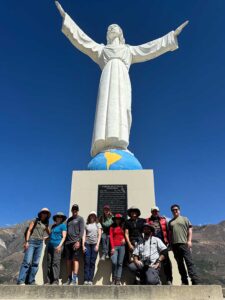
We climbed the hill to the cemetery. There we stood at the looming statue of Jesus in silence and awe of the power and the stillness that remains.
We continued upward through a deep glacial canyon flanked by the enormous walls of the highest peaks of Huascarán (6,768 m / 22,204) and Chopicalqui (6,354 m / 20,846).
Along this very deep canyon we passed two turquoise glacial lakes, Chinancocha and Orconcocha.
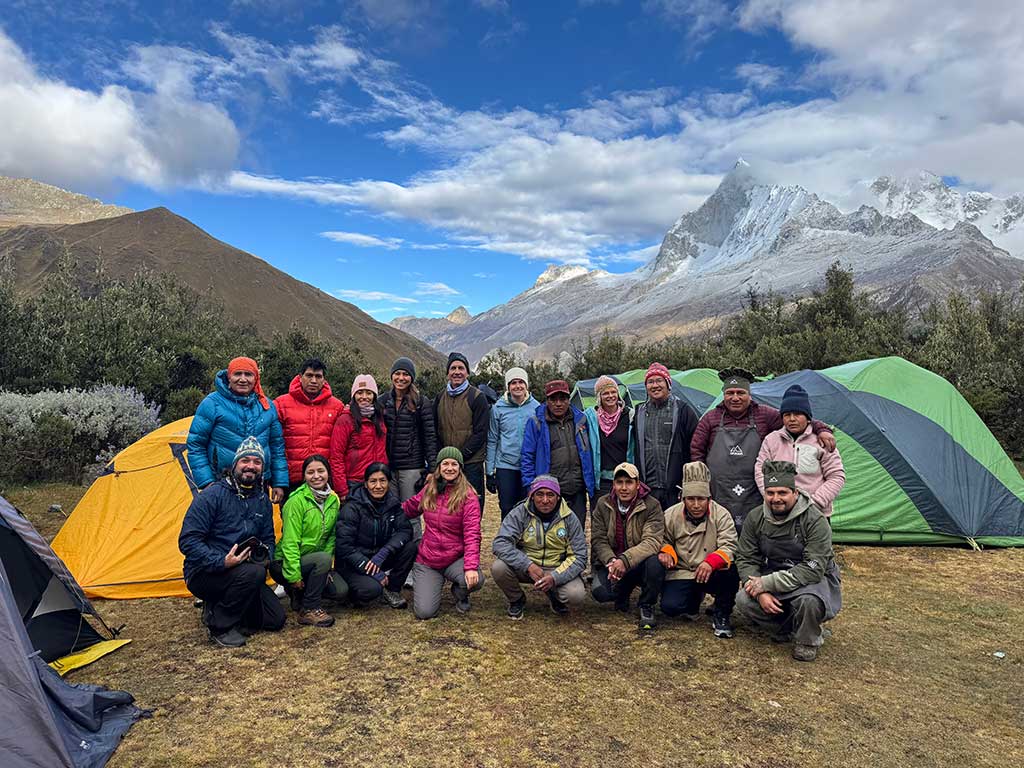
Next, we arrived at our high mountain mobile camp. After a lunch of “ceviche peruano,” a local specialty (I’m not a fan), we were driven several hundred meters up above the camp, on a serious road of infinite switchbacks and hairpin turns.
On the hike back to camp, the wildflowers were blooming and we were in no rush. The sun set and lit the mountains on fire. The stars were brilliant and I caught a glimpse of the Southern Cross. It was cold but our tents were well equipped. I slept deeply.
I was learning that there is so much more to Peru than I ever imagined. Stay tuned for more of this literally breathtaking adventure in Part II next month.





One Comment
Pingback: Beyond Machu Picchu Part 2 - Descent from the High Andes to Lima - The West End News