Book Short
We Are Water
By Wally Lamb
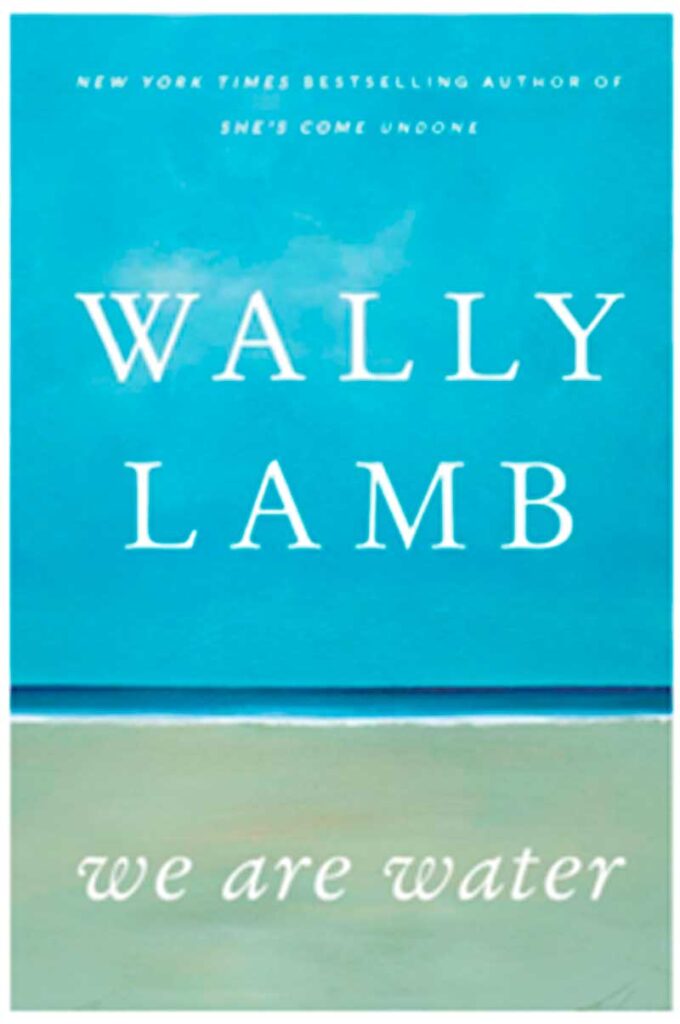
The “perfect” Connecticut marriage falls apart like a peeled onion. Every chapter, told in alternating voices of the husband, wife, daughters, and son, reveals more secrets and pain and missed opportunity. Yet, there is a healing that is woven through the story revealed in equal parts loyalty, self-assessment, and forgiveness.
After twenty-seven years of marriage, Annie Oh reveals that she is in love with Viveca, the wealthy, self-assured Manhattan art dealer who represents her and is the power behind much of Oh’s professional success.
Even more shocking to her psychologist ex-husband, she wants to be married in Three Rivers where they raised their children, now in a state that has just legalized gay marriage. All five members of the family strip away layers of long festering memories as they try to understand Annie’s choice and the complexities of their upbringing.
A Suspicious Subplot
The prologue is in the voice of one of Annie’s mentors, an artist and former head of the Statler Museum, who awards her first blue ribbon. This gives rise to a subplot, the suspicious death in Three Rivers of a promising young Black artist of the American primitive style who is recognized by the art world only decades after his death.
That artist’s murder and posthumous rise to fame both parallels and mocks Annie’s own artistic career success. It’s an intriguing and well constructed instrument to highlight the external forces pressuring the Oh family struggle.
Interestingly, Viveca is not given a direct voice in the narrative, and she is both a very engaging personality and an unlikeable bully. Her manipulative influence — not just on Annie, but on each of them — often seems contrived. In the end, I feel she is redeemed. Perhaps, I felt at the epilogue, she really is just a kind but forceful Manhattanite and self-made businesswomen who, as we all do, likes to get her way.
An Experiential Novel
The fifth of Wally Lamb’s novels, this has the texture of “She’s Come Undone,” with a gauzy overlay that doesn’t quite reveal but hints at the outlines of every shape. That veneer opposes the beautiful clarity of the writing and gives the entire book a sense of underwater immersion — which makes the title (cleverly revealed late in the plot) descriptive as well as experiential.
Each character has hidden, dark truths that painfully rise to the surface to astonish the others and be forgiven in turn. In fact, it almost seems unreal how well connected the characters are to each other given the amount of trauma they’ve survived.
Micro Shorts
“Amity“
By Nathan Harris
I reviewed his “Sweetness of Water” debut novel last month, and “Amity” is a pretty terrific second work by this young American author.
Built from real Black experiences during the Civil War, Amity is a community of ex-slaves in Mexico who become warriors-for-hire to various governments and armies in exchange for being otherwise left to live as they choose in an isolated section of the desert. Newcomers are struck by how Black children run around the town playing with abandon – an unimaginable public freedom for former slaves.
As in his first novel, Harris explores how “freed” slaves struggle to shake off the emotional trauma that shackles them to their former masters and shows how it might be possible to become free by being true to yourself. The prose is beautiful and the story of reunification of a beloved brother and sister is complex but engaging.
Now with two amazing novels published, I can’t wait to see what Nathan Harris does next!
“Women Talking”
By Miriam Toews
Based on a true story where women in an isolated Mennonite community – including several teenagers and one three-year-old girl – are dosed with animal anesthesia while sleeping in their beds and repeatedly raped by a group of men who are their brothers, husbands, and community leaders.
“Women Talking” came out in 2018 and was made into a movie last year. It presents a provocative notion – that civil debate of ideas is a form of empowerment as well as resistance. Accordingly, despite that dramatic and horrible backstory, not much happens other than the victims gather secretly in a hayloft to discuss and argue their options, namely: Do nothing, Leave, or Stay and Fight. “Fight” in some of their minds means taking a scythe to the rapists, who are at this moment being bailed out of jail by the rest of the village men.
It’s hard not to become distracted by how angry this (true!) scenario made me, but the women are consistently kind, thoughtful, and empathetic – even arguing that fighting back makes them perpetrators and thus no better than the men who abused them.
The women come to the realization that the animals of their colony are better protected than they are. It’s not easy to read this novel, but it is a striking commentary on power, cult religious fervor, and compassion.
“Murder in Chianti, A Tuscan Mystery“
By Camilla Trinchieri
Former NYPD homicide detective Nico Doyle moves to the hometown of his late wife, hoping to mourn her in peace among the only family he has left. A gunshot in the woods one early morning destroys that wish, and he reluctantly agrees to help the local maresciallo (chief of police) uncover every last secret in the place to find the murderer. This is a lively, uncomplicated novel full of fabulous Tuscan meals and coffees interspersed with a detective story. Mange!
“Whereabouts, A Novel”
By Jhumpa Lahiri
Pulitzer prize-winning author of “Interpreter of Maladies” and “The Namesake” addresses both the weight and the joyfulness of solitude in this collection of daily diary entries by an unnamed middle-aged woman in an unspecified city.
Quotidian moments alternately bring comfort or despair, stoke remembrances of a sad childhood, and spark romantic desire. The writing is spare and poetic but not sentimental. Roaring traffic and busy cafes inspire as much as sunrises, mountain views, and stormy beaches. Throughout there is a low-level anxiety that begins to demand attention. Is happiness within grasp?
One of my favorite chapter endings illustrates the narrator’s struggle between a yearning for change and a personal timidity toward action:
“Outside there is a ferocious noise coming from the crashing of the waves and the roar of the wind: a perpetual agitation, a thundering boom that devours everything. I wonder why we find it so reassuring.”
“Patriot, a Memoir“
By Alexei Navalny
My biggest question for Russian revolutionary Alexei Navalny doesn’t get answered until the epilogue. Why did you go back to Moscow after recovering in Germany from being nearly fatally poisoned, despite knowing you would be imprisoned and likely killed? Why?! (Spoiler: He says it’s a combination of acceptance, hope, and faith.)
Turns out, this is a man with incredible drive, determination, unwavering love of country, and vision. He’s a great writer and has an admirable sense of humor considering most of the book is drawn from diaries and Instagram posts from his last four years in terrible prisons. Since we know the dastardly ending, it’s a hard book to read, but his stamina, passion, and “prison Zen” almost make you forget that he’s being tortured. Almost.
If you want to understand what it means to truly risk it all for your country, read this book. If you want to understand what we can do as individuals who are not as brave or determined, read this book.
“North Woods“
By Daniel Mason
This epic, award-winning novel has an intriguing center. It’s the story of a place. Namely, a home nestled in the New England woods, and all the various people who lived there. It starts with a highly amorous couple who escaped a Puritan camp in the early days of European settlement.
Chapters are of varied length, several in poetic form, one epistolary, two from the perspective of fungi and spores that take down the American Chestnut, and one as a modern real estate listing. Most include a mystic element, if not outright ghostly hauntings. A half dozen people and nearly an entire orchard are chopped to death by axe.
It’s a highly imaginative approach about place, human loneliness and striving, and the healing properties of a good, long walk in the woods. That said, the third party, omniscient viewpoint dulls as the novel wears on, and I found some of the storytelling dense.