
Book Short
Reviews by Stephanie Miller
‘The Sweetness of Water’
By Nathan Harris
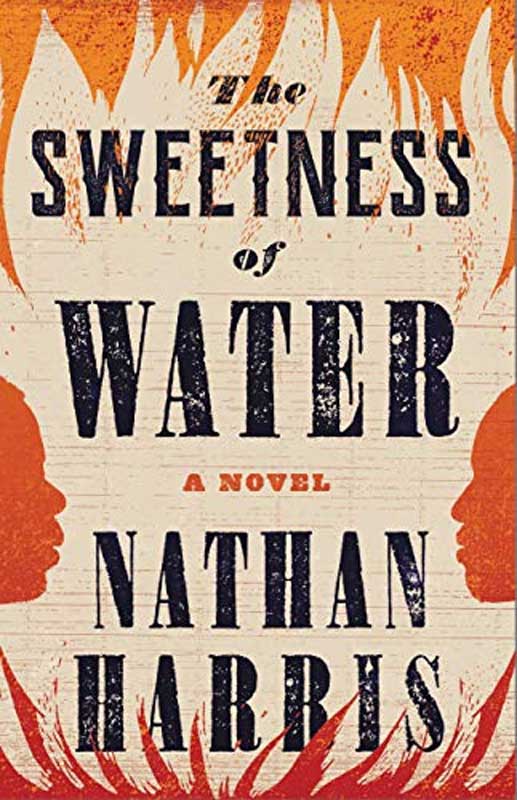
Two brothers, Prentiss and Landry, freed by the Emancipation Proclamation, camp in the Georgia woods owned by farmer George Walker, a reclusive and mostly lazy neighbor to their former plantation home. Devastated by the news of his soldier son’s demise, Walker hires the brothers to transform his farm. Wary, they accept to earn money to go north.
Thus frames the story encompassing the entire town of Old Ox as it deals with grief, a large number of newly free citizens, and the painful transition to a fractious post-war reality. The plot is driven by the result of an illicit affair between two soldiers, which has tragic consequences for the brothers and Walkers. George’s wife Isabelle holds the story’s healing power, helping the community and the land recover from all the chaos.
A Refreshing Debut Novel
“Sweetness of Water” is Harris’s debut novel and refreshingly doesn’t contain the typical racial animosity we expect from post-Civil War novels. Instead, there is a kinship between the Black and white characters that sputters and cackles and deepens and solidifies.
This surprising kindness between folks starts early. After finding the brothers in his woods and chatting for a while, Walker turns to leave but realizes his sore hip will prevent him from getting home:
“I should be heading home,” George said. “My wife will be worried. If you could give me some assistance … I’d make it worth your while.”
Prentiss was already standing to help.
“I mean, you two could stay here, if you wished to. For a time.”
“Let’s not worry about that right yet,” Prentiss said.
“And if there is something else I could assist you with, perhaps.”
Ignoring George, Prentiss put a hand beneath his arm and lifted him in one swoop, before the pain could set in.
“Just like that,” Prentiss said. “Slow-like.”
The characters are boldly drawn, but most of the story takes place in their emotional, internal narratives in response to the volatile world that is collapsing and evolving around them. Surprising but beautiful friendships evolve. Despite this sentimental approach, it’s not overly melodramatic and the characters remain steadfast to their natures and each other.
It’s also a great imagining of the period of reconstruction and shows how a nation heals itself through countless personal choices of patient open-mindedness through individual, imperfect relationships.
Perhaps that is a lesson for our time, and all time.
Micro Shorts
‘Euphoria: Ten Maine Stories’
By Dave Patterson (MAINE AUTHOR)
If you went to an old, semi-gentrified mill town in Maine, sat in the local diner for seven or eight hours, and talked to the people who sit near you at the counter, you’d meet the people in Dave Patterson’s “Euphoria” stories.
Longtime residents, recently arrived immigrants, wealthy, striving, struggling, afraid, optimistic, or sad beyond hope – these stories are full of what makes any small town uniquely itself. They are smoothly written with engaging characters that you’d really like to share a coffee and maybe a cherry pie with at the diner.
‘The Floor of Heaven, A True Tale of the Last Frontier and the Yukon Gold Rush’
By Howard Blum
Here is the history of the second major gold rush in North America, told through the intertwined stories of three larger than life characters:
- Charles Siringo, cowboy detective
- Jefferson Soapy Smith, the gambler who built an underworld empire
- George Carmack, the prospector whose discovery set off the stampede to the Yukon
In the last decade of the 19th Century, the Wild West has been tamed. Real heroes were bored. Suddenly a new frontier opens with the Yukon gold rush.
These three and their compatriots were the tech bros of the late 1800s. The country is in a depression after a stock market crash. Gold is at a premium as the only safe currency. So these three dream big. Work hard. Fail. Try again. Reinvent themselves. At about the halfway point, readers are let in on the intersection between the three men’s lives, where ambition meets morality meets evolving norms.
It’s a remarkably fast paced read for nonfiction, and an ambitious approach to tell the larger story through the lives of three men.
‘Lonesome Dove’
By Larry McMurtry
Three cheers for books clubs! I would never have picked up this 900-page “Mother of all Westerns” tome if it was not suggested in memory of the recently passed Robert Duval, who played the starring role in the mini-series (which I have not seen).
The basic plot is that two former Texas Rangers lead a herd of cattle and remuda (great word!) of horses from the Rio Grande to Montana. Despite taking what feels like every dusty, thirsty, dangerous step of the way with them, it’s a very compelling read. It has a sort of omni-narrative point of view, and the fluidity of transition between the inner dialogues of the various characters, sometimes in the same paragraph, give the novel lift and energy. That prose precision and beautiful writing helped me get over the mostly one-dimensional characters (with two exceptions) and the limited voice given to the women.
Research by one of our book club members showed that McMurtry was trying to represent the “authentic Wild West” life of real cowboys and dispute the myths presented by most other western novels and action movies. Bottom line: I enjoyed it more than I expected!
‘Passing’
By Nella Larsen
One of the classics I read during Black History Month is this 1929 novel about two Black women who are passing as white but in very different ways. Fascinating to me is that the act of passing is done so much in the open, and race throughout the novel is a bit slippery and elusive. The two women are opposites but stay true to their characters right up to the tragic end.
‘The Color Purple‘
By Alice Walker
This epic lament to love is worth reading again. Two sisters grow up with an abusive, predatory father and their escape separates them. The novel is written in letters which explore the big questions of life. The prose is beautiful and the characters are majestic. At the end, the author’s epilogue reads, “I thank everybody in this book for coming.” Me, too.
‘Red at the Bone‘
By Jaqueline Woodson
In a multi-generational story of privilege, personal identity, and parenthood, this novel by award winning author of “Brown Girl Dreaming” opens at sixteen-year-old Melody’s coming of age ceremony in her grandparents’ Brooklyn brownstone. Melody is wearing the dress intended for her mother, who, pregnant, abandoned her debut and ran away to escape her parent’s disappointment.
The eloquent and deeply emotional narrative spins between these three generations of women who are vastly different, but deeply connected by the mistakes of the past. Meanwhile, what teenager is ready to declare the pattern of their life? Melody certainly is not, nor does she fully appreciate the impact of being pressured into making choices before she fully knows herself. I found myself wanting to sit down with all of them and hash out these life decisions together!
‘The Ride of Her Life, The True Story of a Woman Her Horse, and Their Last-Chance Journey Across America‘
By Elizabeth Letts
This is a true story of Minot, Maine’s “most famous citizen:” Annie Walker, who left her failed farm at the age of 62 in 1954. She’s heading to California on a horse, accompanied by her faithful spaniel. Before this journey, she had never been further south than Portland.
At her first stop to pick up mail in Springfield, MA a fan enclosed a letter from Maine’s governor to deliver to the Governor of Idaho, from one state famed for potatoes to another. With that and the support of a thousand strangers she meets along the way, Annie keeps going west.
She learns some fascinating things about herself and America:
- Springfield, MA was the home to Milton Bradley company, creator of the newly launched game, “The Checkered Game of Life.”
- Strangers are a lot more generous than you’d think they’d be.
- She never guessed how little money she’d have to spend along the way. “Annie had paid for so few meals and so few beds and she had been turning a tidy profit in nickels and dimes as she’d sold her autographed notecards.”
- Meets up with a local named “Andy” (Andrew Wyeth) in a tavern in Media, PA, with whom she shared a meal and regaled he and his wife for hours with stories from the road. In the morning, she found him sketching her horse but told him to hurry up and finish since she had to get on her way.
- About halfway between Cheyenne and Laramie, Annie visits a local roadside attraction known as the Tree in the Rock that marks “where the workers building the Union Pacific had detoured the tracks around a limber pine that appeared to be growing directly out of a crack in a boulder.”
Art Linkletter sponsored her last leg down the Central Valley of California “Not only was her calm assurance infectious,” he said, “But she also transmitted the quiet strength of her personal philosophy – that happiness comes only to those who participate in the adventure of life, and that true security is, in essence, a state of mind.”







One Comment
Pingback: Book Short - 'We Are Water' by Wally Lamb - The West End News