Book Short
‘The Emperor of Gladness‘
By Ocean Vuong
By Stephanie Miller
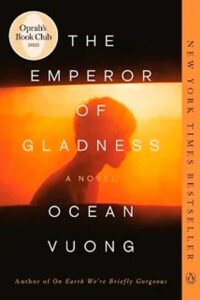
Vuong’s beautiful, misty prose follows the story of two Vietnamese American cousins struggling to find their place in a world and culture that seem to drag them down despite their heroic efforts to achieve modest ambitions.
It’s a story of people on the edge of survival – and sanity – and is a richly written telling of ordinary, flawed, but spirited people with very little material wealth doing their best to be kind and good to others.
A thematic line borrowed from Fyodor Dostoevsky’s “The Brothers Karamazov” appears during a pivotal memory/reflection. The protagonist Hai’s mother tells her son, “But don’t be afraid of life… Life is good when we do good things for each other.” (For the purists among us, the original quote from Dostoevsky’s “Speech at the Stone” is: “How good life is when one does something good and just!”)
In the beginning…
In the beginning, on a rainy summer night in a worn-out neighborhood in East Gladness, Connecticut, nineteen-year-old Hai stands on the edge of a bridge ready to jump when he hears someone shout. The voice belongs to Grazina, an elderly widow slowly dissolving into dementia, who convinces him to come down again. He becomes her caretaker and the unlikely pair develop a life-altering bond built mostly from heartbreak. Each give all they have, which is just enough to prop up the other.
When Hai enters rehab, he reflects:
“Every generation says this of itself but these were indeed bewildering and unprecedented times he lived in. A time before iPhones were everywhere, and people still looked up as they walked, their heads filled with self-generated thoughts floating up from deep pits in their subconscious. Time when you still knocked on each other’s doors, and if you wanted to talk to somebody you had to call them, […] then meet up somewhere, one of you waiting about, shifting your feet and looking at clouds or trees or municipal architecture. A time when the drug dealer on the corner would, out of boredom, start balancing on a chain link fence, the boy in him unable to help it, pants sagging from the effort, revealing his plaid boxers you can see from the back window of the school bus.”
Hai later tries to explain that he can’t help his cousin, that he’s struggling just as much, that he’s vulnerable and weak like everyone they know:
“Look, touch me,” Hai says. “’Go ahead, grab on.’ He held out his arm and Sony squeezed it, cautious. Harder. See? That’s the only real thing about me […] Everything else, what I’ve done, the goals and promises, they’re all like ghosts floating away […] caught in all the places I snagged myself.”
The prose is gorgeous throughout – with a final chapter I read three times in a row and sentences like, “She sounds tired, like she had just finished returning enormous things to where they belonged,” sprinkled throughout that make you stop and just appreciate the beauty of words so carefully placed.
Micro Shorts
“The Savage, Noble, Death of Babs Dionne“
By Ron Currie (MAINE AUTHOR)
If the Godfather story combined with a mystery and placed itself amid a deadly war for the illegal pharmaceutical trade in Waterville, Maine, we’d get this fast-paced, unforgiving view of a damaged and fierce crime boss desperate to save her town, her French-Canadian neighborhood, and her family. The title is an indication that author Ron Currie fell in love with some of his characters – including Babs, her priest-confessor-lover, and a professional killer called The Man – since he treats them with such care and lets them be audacious and cunning and even tender. Despite the intense impact of addiction and trauma on this family, there is also love and hope and loyalty.
“Twilight Garden“
By Sara Nisha Adams
In a small London neighborhood, there is a neglected garden shared by two feuding neighbors. In this pleasant second novel by Sara Nisha Adams, the revitalization of the garden becomes a metaphor for each dealing with their own family and life dramas and coming to realize the power of friendship and community. While the neighbors don’t become besties, they do evolve to care for each other, recognizing individual strengths and learning wisdom while bringing the garden back to life. I had a little trouble connecting to the characters, but I appreciate that Adams brought into this story of small spaces and ordinary lives some complex themes around grief and systemic racism. I liked it enough to seek out her first novel, “The Reading List.” Stay tuned!
“Miss Jane”
By Brad Watson
Miss Jane Chisolm, born in rural Mississippi with a birth defect that excludes her from traditional female roles of wife and mother, has a chance to live a life outside the expectations of her early 20th Century town. Based on the true story of his great-aunt, Watson presents the story from the perspective of a young, vivacious child who doesn’t know she’s different until she perceives the shame of her mother and the taunts of other children.
She persists. Desperate to experience love and adventure, and developing a bit of steel amid her innocence, she eventually settles into a dignified existence of otherness that gives her enlightened perspective, compassion for others, and what I think is lasting happiness. I found this story intoxicating. It was full of reminders of things that make us content — nature walks, summer evening talks by moonlight, good books, profitable industry, and self-pride.
“Tip of the Iceberg, My 3,000-Mile Journey Around Wild Alaska, The Last Great American Frontier“
By Mark Adams
Travelogues are not really my thing. But I heard author Mark Adams speak on Maine Public Radio of his trip that followed the path of the famous 1899 Edward H. Harriman exploration of the glaciers with a crew of scientists and writers and the famous soon-to-be eco-prophet John Muir.
Back then, Harriman was a famous railroad magnate. He fitted out an old steamship as a luxury “floating university” to accommodate all these illustrious guests, ensuring good conversation and well-trained support for his hunting trips along the coast from Vancouver to Dutch Harbor in the Aleutian Islands.
Adams weaves his own experiences on top of stories from the Harriman expedition journals and published reports. Lots of things have changed in 100-ish years. Some glaciers continued to retreat while other grew. Town fortunes evolved from gold rush to cruise ship hospitality. Many fewer native settlements survive. Of course, some stayed the same. People living in Alaska are still dreamers, definitely weird, and proud of their resilience and isolation.
It’s a fascinating history of these truly spectacular coastal areas along with a respectful introduction of some of the people who live there (when Harriman visited and now). It is also a celebration of nature and human fortitude. I find it hard to believe that anyone would read this history plus travel diary and NOT yearn to take off for the Alaskan wilds. (I did!)
“Magnitude“
By Jennifer A. Nielsen
This Young Adult book about a massively destructive earthquake was on the featured shelf of the downtown Portland Library. I picked it up because I once lived through a small earthquake in San Francisco myself. This story of three teenagers of very different circumstances desperately trying to reunite with their families while trapped in rubble, politics, and adult rivalries, was full of historical facts of the big quake in 1906.
Subheadings for each chapter illustrate the timeline of how literally half the town was burned down by the army in a misguided and ill-managed attempt to stop the fires started by the earthquake. The kids find themselves in the middle of a criminal escapade, as the corrupt mayor raids the bank and sends the police out to loot homes while ostensibly there to protect homeowners from looting.
Like all good children’s books, it tackles how we must struggle with basic values: honesty, friendship, mercy, and compassion. I recommend it for anyone in search of a tween historical fiction for themselves or a young friend.
“Wise Gals: The Spies Who Built the CIA and Changed the Future of Espionage“
By Nathalia Holt
The “founding mothers” of the CIA helped set the agency in motion and build its credibility during WW2 and the subsequent Cold War years. Most never got paid their worth or received any recognition.
“Wartime, by its nature, had led to chaos in the intelligence community,” and despite handing out cash to every degenerate or grifter with a story, the Americans were trying to catch up to the caliber of British and Soviet spies. When future CIA chief Allen Dulles said in the 1950’s that “women make fine spies” he may have had these pioneering women in mind.
The first CIA officer to be killed in the line of service, Jane Burrell, “had a lasting impact on the future of American intelligence” – as her system for recruiting and handling spies and techniques would “guide the activities of the CIA over the next four decades.”
Another agent, Elizabeth Sudmeier was the only CIA employee choosing to remain in Baghdad after the military coup in 1958, single-handedly managing and retaining the network she and others had so carefully built, including gathering precious intelligence on new Soviet fighter planes.
This handful of ambitious women fought against the agency’s deeply held conviction that promoting or developing the skills of women agents was fruitless, as they, especially married women, would just start having babies and quit.
“Subject’s sex and family circumstances make her a difficult rotation assignment in the communications field” was typed into Addy Hawkin’s personnel report, serving as an anchor for her long career.
In 1956, 22 of these successful, if undervalued, women spies joined together to write a report on female discrimination. Over eight months, they convened after hours in a hot, stinky, tin warehouse to battle for data to make their case. Male colleagues jovially nicknamed them the Petticoat Panel, a moniker they embraced as illustrative of the blatant sexism and misogyny. They knew exactly what preconceived arguments would be used against them. Yet, they tackled both change at the agency level and societal level in the report:
“It is probably offensive to many men to find a woman occupying positions superior or even equivalent to theirs. It is also probable that many women prefer to work for men. In part, this preference comes from a traditional attitude toward women which will be affected only through a slow evolution of sociological change.”
Most of us can guess what happened when they presented their detailed, data-rich report on the pay inequities and lack of promotion opportunities for women at the agency. (Spoiler: It was openly dismissed.)
“The Gales of November: The Sinking of the Edmund Fitzgerald“
By Robert J. Hemming
Once again, I bow to the power of book clubs to introduce you to books you would never pick up otherwise. I really enjoyed this nonfiction account of one of the largest – and thanks to the Gordon Lightfoot ballad, perhaps the best known – shipwreck on the Great Lakes, which went down in a massive November 1975 storm.
I was fascinated to learn about the Lakes. For instance, their freshwater wave patterns and high storms require maritime skills far more complex than the ocean. The Lakes are an incredible economic engine to this day and back in the 1960s-70s commanded the energy and manufacturing trade.
Hemming follows the lives of several crew members as well as pieces together what happened that fateful day through known accounts and news reporting. He honors the families of the sailors, who are ordinary people carrying an incredible public grief. But he also tries to erase misguided claims of blame on the captain and engine room workers.
The “Fitz” was an engineering marvel of her day. Crowds gathered with picnics to see her come through the locks. The corporate owners really leveraged her as both a workhorse – with probable cheating on loads larger than regulation – and a showpiece. The ship included a couple of VIP cabins, a celebrated chef, and a crew of porters to make the invitation-only opportunity to sail on an industrial freighter a luxurious and rare treat. It made me feel better that the sailors also ate pretty well!