
By Nancy English
As warm weather pulls blossoms and green leaves from the dry branches of trees, another phenomenon awaits walkers in downtown Portland. Public drug use and mental illness put us face to face with the suffering of people with substance use disorder and other severe health issues. It’s hard to see and harder by far to live with. It is also an impossible challenge for city, county, and state government and many nonprofits struggling to help.
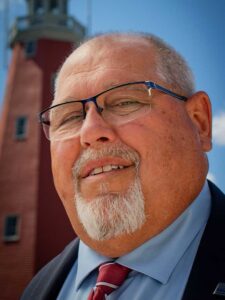
“No one is accountable,” said Mayor Mark Dion. “If judges and prosecutors were serious, there would be a sentence for a length of time that’s therapeutic.” That would be for longer than the typical three to four days resulting from an arrest. Otherwise, “We are just enabling this condition to continue.”
“We can’t be afraid to put people in the criminal justice system, but we are,” Mayor Dion said. Instead, we watch as people are “committing slow suicide” in public.
By example, an anonymous SeeClickFix request, from a public city services app, in the category of “Homeless Camp” reported, on April 23rd, 2026, “…People passed out on a sidewalk, completely blocking any passage. People are lying face down on the sidewalk in utter despair.”
‘I wish there was a kinder way…’
Judy Sandler, from Lincolnville, is the author of “What Kind of Mother, A Reckoning,” arriving in September by the West Virginia University Press. In it she describes how her son, suffering from bipolar disorder and substance use disorder, walked the streets of Portland before police arrested him more than once.
“A friend of his called and told us he was in jail,” she said. But the jail would not say why. “We didn’t understand the extent of the drug use till we entered his house and found used needles… Everything he owned was stolen, down to the toilet seat.”
At one time her son waited in the Emergency Department of Maine Medical Center for four days before they gave him a bed, Sandler said. “ED Boarding,” long stays in emergency departments, is a nationwide problem because of the lack of beds for patients, including those with mental illness.
Ultimately it was a ten-day jail sentence in Cumberland County Jail that persuaded her son to begin taking psychiatric drugs, because he didn’t want to ever be in jail again.

“We stabilize them,” said Cumberland County Sheriff Kevin Joyce. “Forced medication is not done in jail. If you think we’re fixing people, that’s wrong. Recovery should happen elsewhere.”
“I wish there was a kinder way we could separate our mental health patients from criminals,” Sandler said. But Spring Harbor, Portland’s closest mental health hospital, does not accept people in custody.
Sheriff Joyce pointed out that, “Eighty percent of the jail population has substance use disorder or mental illness or both… Some people but for SUD or mental illness would not be here. We need to find a way to deal with that issue before they are arrested.”
‘We need to find an alternative to incarceration.’
The statewide crisis intervention number, 988, connects callers to local county crisis workers. In Portland, they might refer someone to the “Living Room” run by Spurwink Services, open 24/7 and the “gold standard,” according to Margo Walsh, who is the owner and founder of MaineWorks, which finds employment for workers released from jail or otherwise seeking a second chance.
The Portland Homeless Services Center, a shelter with more than 250 beds that is typically full, also offers mental health services. Cary Tyson, Executive Director of Portland Downtown, said, “It’s better than the Air Force barracks I lived in.” Others call it a source of municipal pride, a well-run refuge that finds housing for clients ready for it.
“Social services intervention, as well intended as it is, actually exacerbates the problem.,” Walsh said, “But we need to find an alternative to incarceration.”
‘There is help if they want it.’
Jonathan Bachelder is a MaineWorks client employed at the renovation of Maine Bank & Trust. “There is help if they want it,” he said on a cigarette break. The disorder in the street he sees in the early morning when he arrives for work, the trash cans tipped over, the trash-filled bus shelter, disturb him. “It should be policed more.”
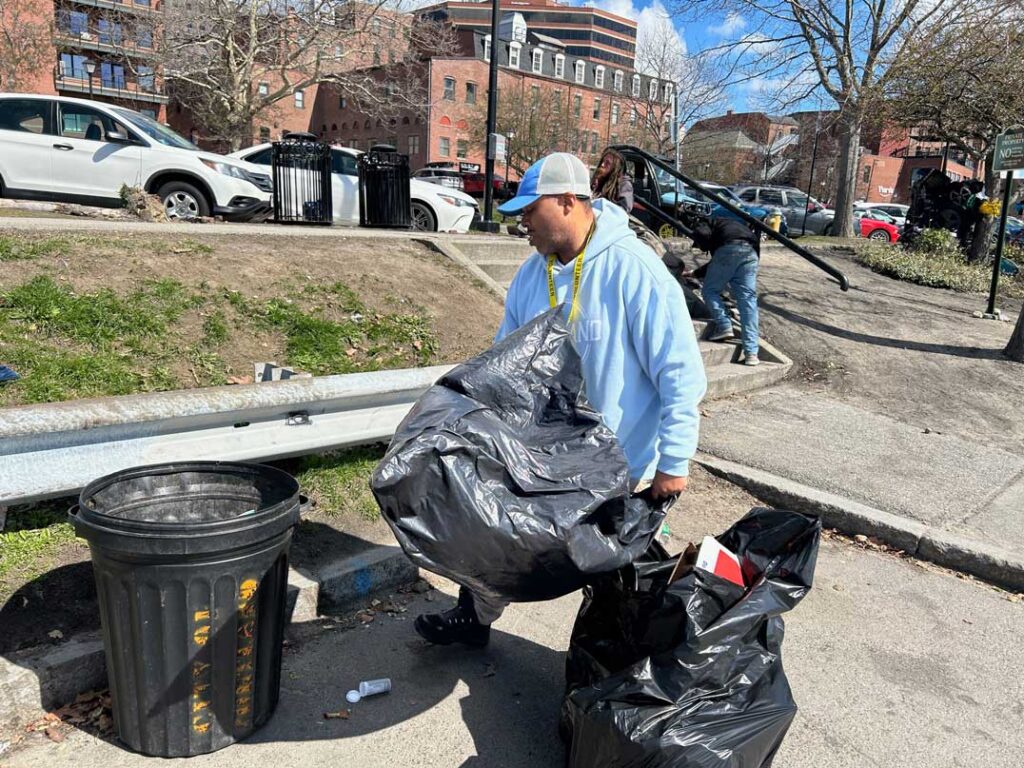
Constables working for the Police Department now patrol the city streets but do not arrest anyone. Tyson is still hiring for the Portland Downtown Ambassador Program, building a fifteen-person team to clean sidewalks from early morning until 9 p.m.
Milestone on India Street runs a shelter, detox, and residential recovery center on Andover Road, according to Joe McNally, its Director of Homeless Services. It is just one of many local resources now available to people with SUD.
But those also suffering from mental illness, Sandler said, may not even understand the severity of their condition. Unless behavioral health experts and the courts intervene, jail seems almost inevitable.
Next in this two-part article, you will find a report about civil liberties and what precisely constitutes a threat to oneself or others. Evidence of that threat is the basis for involuntary treatment.








One Comment
Pingback: Social Workers Champion their Homeless Clients in Portland, Maine - The West End News