Book Short
By Stephanie Miller
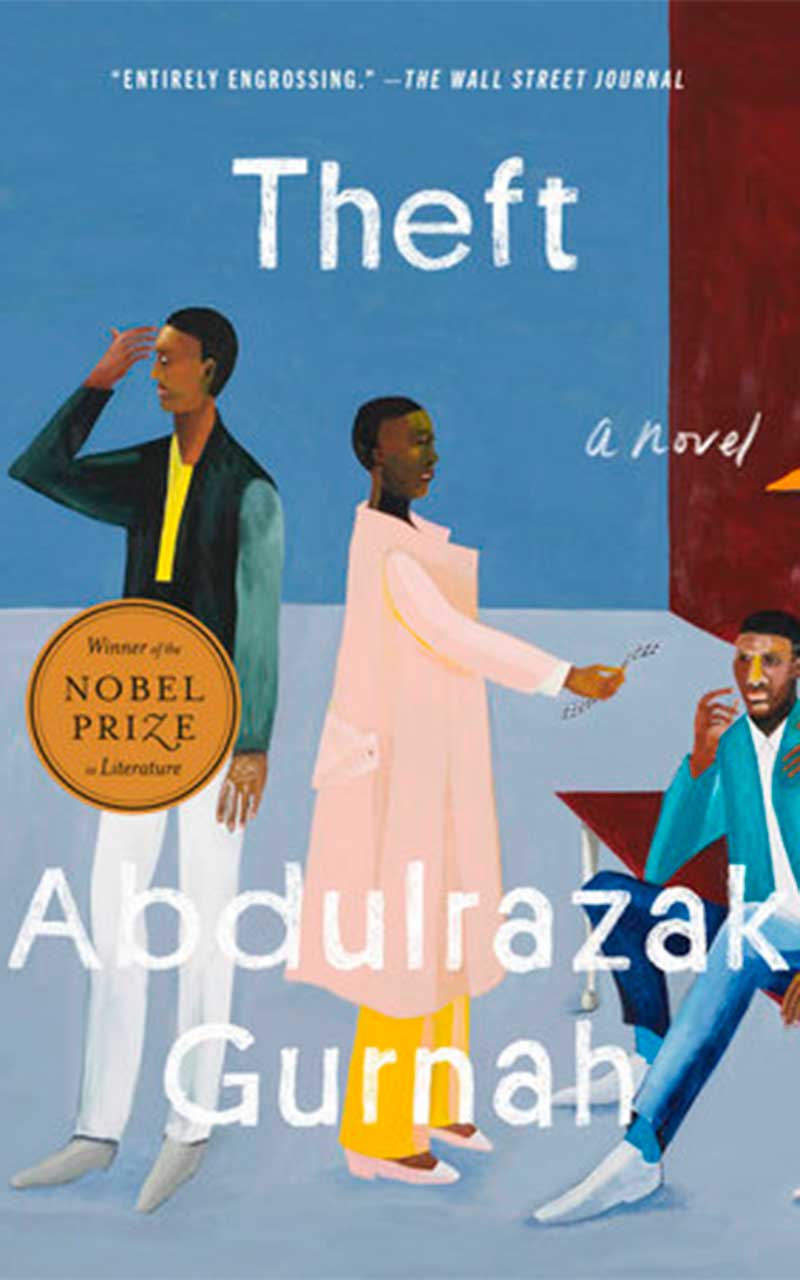
Three young people come of age in Tanzania at the turn of the 21st Century – a time of rapid change. In “Theft: A Novel,” tourists are flocking to Zanzibar, Nobel-prize winning author Abdulrazak Gurnah’s hometown. Big money arrives with them – new hotels, new people, new employment – but, as Gurnah said in an NPR interview, tourism “also brought many corruptions.”
This strange, new, exotic, dangerous world is where our three protagonists try to make their way. They are seemingly powerless and weighed down by either a literal or emotional abandonment by their parents. And so, they each begin a hero’s journey to get themselves closer to happiness, love, and security.
Karim, Fauzia, and Badir Grow Up
Before he returned with a swagger to his hometown from university, Karim was just another poor boy raised mostly by his grandparents. Fauzia, disillusioned from an early arranged marriage with an abuser, locks in on him as a kind of savior. Together, they take in Badir, another poor boy whose similar background to Karim would seemingly make them kindred spirits. Badir, told since his sixth year that he is worthless, expects little and is grateful for any comfort. His infinite patience is actually a kind of slow cooking ambition.
Enter tourism, technology, and new opportunities for each of them. What will they do with their chances?
I read this novel while on a flight to Europe and being so far above ground may have tuned me into its unearthly aura. Beyond dramatic external events – a brutal civil war, the abandonment of traditional norms to embrace foreign visitors, and all the unethical striving that typically accompanies new wealth – not a lot happens. Basically, three rather ordinary people grow up.
They are victims of the kind of tough family love that comes from generations of disappointed fates and poverty, and they find love (sometimes fleeting), thrive in their careers (or not), express their creativity (some with industry, some only imagined), and piece together a life that is woven with ups and downs, fatigues, and joy.
Meander the Streets of Dar es Salaam
But yet, there is a melody here. They see the economic hub of Dar es Salaam sparkling across the water, as tourists flock, spend money, and create jobs for locals. They embrace computers and the internet to earn higher paying jobs. All the while, they have access to world events and cultures, learn English, and try to figure out why people would fly so far just to visit a beach that, in their minds, is unremarkable. Roles evolve. Women are given options outside the home and are no longer solely suppressed by the whims and cruelties of their husbands.
The story meanders through their lives – the narrative switching between them – as they navigate this time and that place. It’s a part of the world that I know nothing about, and I enjoyed being taken to wander through city streets or led coughing through the dust of country roads, and seeing our protagonists thrive alongside a cast of supporting characters who are in their turns untrustworthy or kind, and generally self-interested.
Micro Shorts
“Martha Washington: An American Life“
By Patricia Brady
Overshadowed in modern memory by her more famous fellow colonial first ladies – the wise but often snarky Abigail Adams and the unrivaled political hostess Dolly Madison – Martha Washington still remains the first first lady. And it turns out that she was a much more interesting, romantic, charismatic – and influential – character than I realized.
Historian Patricia Brady explores the life of this loyal and dedicated wife who helped set a bar of graciousness, hospitality, and marital partnership for every following presidential spouse. By destroying all the letters she and her husband exchanged, she protected their privacy but offered little help for future generations to appreciate her true worth and contribution.
Brady’s extensive research outlines Martha’s history. She was a beautiful and lively young widow with an independent fortune and appears to have made a true love match with our George. She was a successful businesswoman and civic leader in her own right. Plus, she was a devoted mother to her own children from her first marriage (point of interest: George blamed her for their lack of offspring), and her many nieces, nephews, and grandchildren.
I loved this history of how they partnered in life and in the birth of the nation. He relied on her for comfort and support during the many campaigns of the Revolution and depended on her political insights and guidance on how to manage his unruly cabinet. She was the reason for that famous line in George’s diary when he left Mount Vernon to take the mantle of founding president, “…I bade adieu to Mount Vernon, to private life, and to domestic felicity.”
With no model before her, she became beloved by demonstrating for the young nation how an accessible, knowledgeable, welcoming, and politically savvy presidential life partner represents the values of our democracy.
“The Great Mann“
By Kyra Davis Lurie
In late 1948, Black residents of the Sugar Hill neighborhood in Los Angeles fought all the way to the Supreme Court to save their mansion homes from the use of racial covenants: legal rules that gave whites the power to evict non-whites from their homes without compensation, regardless of ownership, investments, or longevity.
“The Great Mann,” conceived out of the author’s desire to re-tell “The Great Gatsby” in an African American construct, layers on top of Fitzgerald’s storyline the true account of resiliency and determination among Sugar Hill residents to combat this blatant and cruel form of housing discrimination.
The novel follows the path of Charlie Trammell, a Southern soldier who returns from the front lines of WW2 to face the same punishing racism he thought was erased during his brave service. Charlie follows his cousin to Los Angeles, where many Blacks earned their way to a wealth unimaginable in the South. The most dazzling among them is the mysterious James “Reaper” Mann.
Amid this world of tantalizing possibility, extravagant parties, and questionable romance, Charlie quickly discovers the undertones of racism just as prevalent as in Mississippi.
As a fan of the classic, I found this re-telling impressive, both in ambition and as an exploration of the complexities of Black identity in America.
“The Wedding of the Waters: The Erie Canal and the Making of a Great Nation”
By Peter L. Bernstein
Author and socialist Alexis de Tocqueville observed that “These Americans have a terrible mania for commerce.”
He might as well have been talking about the Erie Canal, which became a gold mine for people seeking to earn great profits from business, money, trade, and industry.
Conceived as a national priority to connect the emerging west with the Atlantic seaboard, the 363-mile canal created a thoroughfare from Lake Erie to the Hudson River. It quickly became a pathway for commerce and leisure travel and arguably enabled the wealth and prominence of New York City.
George Washington himself tried but failed to build a canal in a visionary quest to unite the nation. Washington recognized that the mountains cut the early colonies off from the rest of the nation and could quickly leave them without access to the wealth of the Midwest and beyond. Dewitt Clinton, Governor of New York, shared that vision of national unity, but also saw the great potential for commerce and trade.
They were both right. The canal, when finally opened after decades of political maneuvering, delivered 5x in profits the first two years.
This very readable and fascinating non-fiction presents an epic account of the political squabbles and economic risks and returns, showing how “one narrow ribbon of water forever changed the course of American history.”