Book Short
By Stephanie Miller
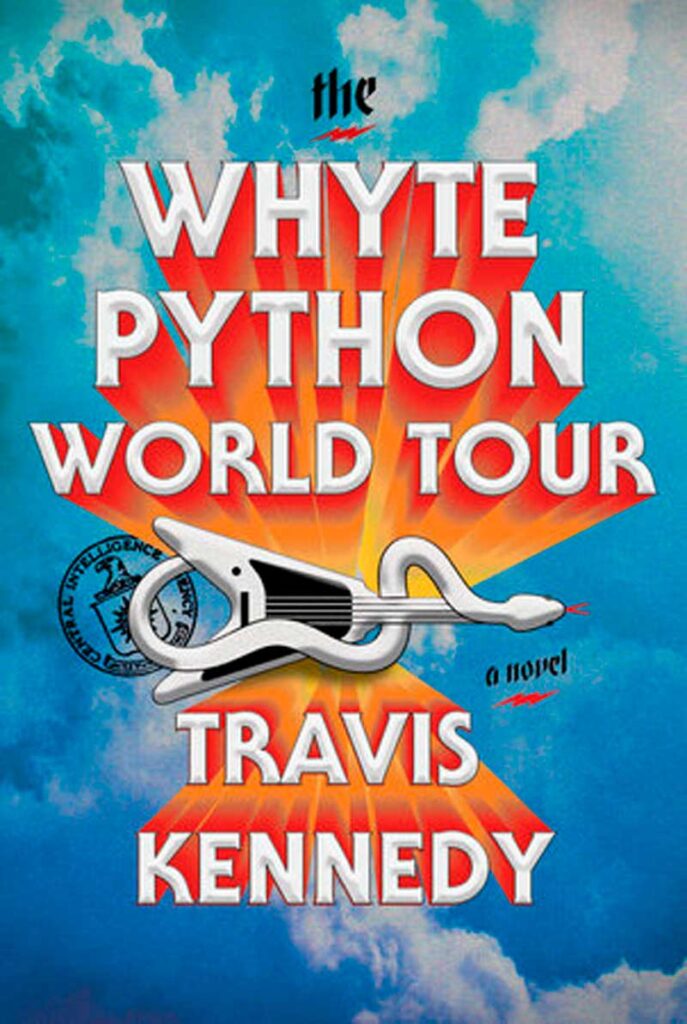
Sometime in 1986, through manipulative and somewhat gruesome methods, the CIA propels the metal garage band Whyte Python to worldwide fame. No one notices the revolutionary lyrics. Except maybe the East German general in charge of the GDR’s secret police. And the tens of thousands of young people in Eastern Europe straining against communist oppression. Light is finally emerging through cracks in the Iron Curtain. The band is so popular that even the Yugoslav general attending a top secret, communist bloc leaders conference asks for tickets.
It’s ridiculously imagined and fearlessly irreverent.
The four band members drink, drug, trash hotel rooms, sleep with bikini-clad women, bite snakes, and take stolen cars for joy rides – all while sporting spandex and high hair. In other words, they party like rock stars. The trope doesn’t overwhelm the plot, though. Some of the CIA operatives and their “asset,” drummer Rikki Thunder, really believe that they could help spread democracy, reduce abject governmental corruption, and ensure everyone has enough food.
When the CIA deputy director welcomes the team, he tells them: “The work you do over the next several years will contribute to one of the most ambitious and unorthodox programs that our agency has ever launched; and if it’s successful, it will promote democracy, improve the safety and standing of the United States, and create an entirely new toolkit for global political-influence programming. Welcome to Project Facemelt.”
As a career marketer, I salute successful messaging that inspires action.
It’s also very timely to consider how government propaganda influences the hearts and minds of citizens. Plus, I’m also reading “The CIA Book Club,” a nonfiction account of our secret service using literature to promote citizen uprising during the Cold War. Music was surely part of that effort, too.
This is a fact that Maine author Travis Kennedy notes in the acknowledgements: “The book is populated with plenty of characters who are inspired by the public personas of real life people. Those characters and their role in the story were wholly imagined and intended to be a tribute to people who were —and still are — larger than life.”
(Case in point: In the novel, Gene Simmons recommends the band change their name to Gerbil.)
Back to the story.
When Rikki gets trained as an asset, he comes to value the goal. “It made me feel sad for all the regular people who were just trying to live their lives, but they couldn’t get jobs and their grocery stores were empty because a group of people with a lot of power didn’t want to let go of it. It made me excited to go there and give these people a hell of a concert, and maybe help them tip the scales a little bit?
”As far as the public knew,” Rikki continues, “I was working on the next album and partying and dating girls from beer commercials. To be clear, I actually was doing all those things. But the playboy lifestyle was almost becoming a cover now, something I did to keep everyone off my back while I studied world history and kicking ass. Metal Bruce Wayne, my dudes.”
Protagonist Rikki charms us throughout with that blend of awe and ego only possible in a skinny, uncool orphan turned twenty-two year old global rock star. But at the end of the day, the book is really about kindness. One small act – and then a whole lot of music, partying, and covert manipulation – has a ripple effect of positivity in the world.
Micro Shorts
‘The General in His Labyrinth‘
By Gabriel García Márquez (Translated by Edith Grossman)
In the hands of Nobel Prizewinning author Gabriel García Márquez, of “Love in the Time of Cholera” and “100 Years of Solitude” fame, the epic story of one of the Western Hemisphere’s most mythical heroes is made real but surrounded with Márquez’s trademark mystical aura.
This is the story of the supreme liberator Simón Bolivar in all his glory, passion, and eccentricities. His dream was to create the largest country in the world. One nation, free and unified, from Mexico to Cape Horn.
We start at the end of his story, when The General is voted out of power and after many of the territories he freed from the Spanish are claiming liberation for themselves as independent nations. We learn his journey in a series of memories occurring out of sequence and with only random and tenuous connection to the present or even the facts of his various battles. There is nothing sadder than a neglected and sidelined military hero. Especially one with such a mixed bag of love and hate for his people.
“He has wrested from Spanish domination an empire five times more vast than all of Europe, he had led twenty years of wars to keep it free and united, and he had governed it with a firm hand until the week before, but when it was time to leave he did not even take away with him the consolation that anyone believed in his departure.”
The novel pulses with sadness and unrequited glory.
Bolivar’s “maniacal dream of continental unity was crumbling, but the dream survived in a single sentence he never tired of repeating, ‘Our enemies will have all the advances until we unify the government of America.’”
The index at the end lists the actual calendar of Bolivar’s campaigns and government. When you read what he actually did, you have an even greater appreciation for how Márquez presents this complicated man: brutal warrior, beloved general, eccentric leader, heartsick lover, and benevolent governor.
‘The Winter of Our Discontent‘
By John Steinbeck
Thanks to some year-end “best of” book list, I opened this late and lesser-known work by John Steinbeck for the first time. I was greeted by the same insight into human pathos and American striving as I love in “Grapes of Wrath” and his other novels. In this, New Englander Ethan Allen Hawley wrestles with our nation’s shoddy attitude toward honesty and success. Why shouldn’t Ethan try to regain some of the former Hawley fortune by grabbing his share of the gain when the opportunity opens?
“Everyone does it. They have been doing it so long, it no longer feels immoral.”
The novel mostly takes place in Ethan’s head. He struggles to understand his need to suddenly become a recognized success in town, to squash the local derision of a Hawley downgraded to a mere grocery clerk, to give his wife a reason to hold up her head.
“Suppose for a limited time, I abolished all the rules, not just some of them. When the objective was reached, could they not be reassumed? And if I should put the rules aside, I know I will have scars. To be alive at all is to have scars.”
Considered a pleasant fool by the town leaders, Hawley lays out his plans. They mostly succeed. But he is agonized by the grief and guilt of becoming one of “them.” It’s when he uncovers the same behavior in his young son that he realizes the full effect of habitual dishonesty. The novel ends with Ethan being saved by his love for his daughter.
Amid this drama, which mirrors any occasion people are presented with opportunities for power and fortune, Steinbeck weaves among Ethan’s inner dialogue many passages of pure poetic prose. Consider these gems:
“Coming out of sleep, I stretched luxuriously. It’s as though the skin has shrunk in the night and one must push it out to daytime size by bulging the muscles, and there is an itching pleasure in it.”
“We walked on the beach as we thought we might, picked up small bright shells and showed them to each other, as we must do; and spoke with conventional wonder about natural things, the sea, the air, the light, the wind cooled sun, as though the Creator were listening in for compliments.”
‘The Resistance Painter‘
By Kath Jonathan
Two sisters come of age in 1939 in Warsaw. Lotka, a nurse, falls in love with a handsome, well-connected surgeon, gaining access to food and money essential to the family’s survival. Irene, an artist in training, becomes a leader in the resistance, bringing danger but also a kind of protection to the family. Paths diverge. Secrets are kept. The horrors of war saturate their lives.
Who can possibly understand choices made under these circumstances? Each sister’s decisions’ result in many deaths, but they each save people, too.
The novel unspools the story with two narrators: Irene and her granddaughter — also an artist. The granddaughter is hired by a seemingly benign old man to build his gravestone sculpture. It’s a love story across many dimensions. But more so, the novel offers a compelling and not overly romanticized story of the incredible resilience and fortitude of the Polish resistance. Especially hard to fathom are the events of the Rising at the end of war, when the Russians stood by to watch the retreating Nazi’s obliterate the frail, under-resourced Poles.
The novel is not historical fiction. However, Jonathan may have been influenced by the life of Hanna Weynerowska (1918–1998). Known as “Kali,” she was a Polish painter and resistance fighter during World War II.