We’re All in This Together
The US Steps Away – What’s Next?
By David Kunhardt
On January 8th, 2026, President Donald Trump, via executive order, withdrew the United States from 66 international organizations, including the United Nations Framework Convention on Climate Change (UNFCCC), the international treaty that forms the basis for all related negotiations. The abdication of US leadership cedes geopolitical and economic progress to China and the EU, but action on climate continues. (See Time magazine and especially Nature.)
Climate change does not respect borders, and, per several members of Congress led by Rep. Doris O. Matsui (D-CA), “Now we are less safe, more isolated, and derelict in our duty as the leader of the free world.” Maine’s Chellie Pingree (D) signed on.
What’s next?
While the US has stepped back, the global climate effort is led by other nations and driven by economic and environmental imperatives, but with significant challenges for global cooperation. The UN’s 30th Conference of Parties (“COP 30”) in November showed some renewed impetus to continue their 2023 resolve to “Transition away from Fossil Fuels,” with more than 80 countries demanding the talks conclude with a roadmap for the phaseout of fossil fuels, in spite of the complete absence of official US presence (as reported by West End News in December).
Since the UNFCCC intersessional meetings last June, Colombia, the Netherlands, and Vanuatu have spearheaded a parallel process to create a “Coalition of the Willing” to design this roadmap that can bypass the in-bred “consensus” process of the COP meetings that allows a few wealthy petro-states to sabotage the efforts of everyone else.
Approximately 60 countries, along with representatives from subnational governments, indigenous peoples, academics, and civil society will gather in Santa Marta, Colombia in April for a week of open dialogues and high-level outcome-oriented meetings. Professional societies and academic institutions, like the American Geophysical Union (AGU) and its new US Academic Alliance are proudly moving ahead. (See especially EARTH.ORG.)
US states, including Maine, and businesses continue to push innovations in energy efficiency, energy storage, and pollution control, without national support. Even Texas now has the largest deployment of wind and solar projects of any US state.
Investors support the economic momentum of renewables
An unstoppable economic shift towards renewables is occurring, creating new markets, though the U.S. risks losing its competitive edge. Renewable energy sources continue to gain twice as much new investment as fossil sources. See the Wall Street Journal report on 2025:
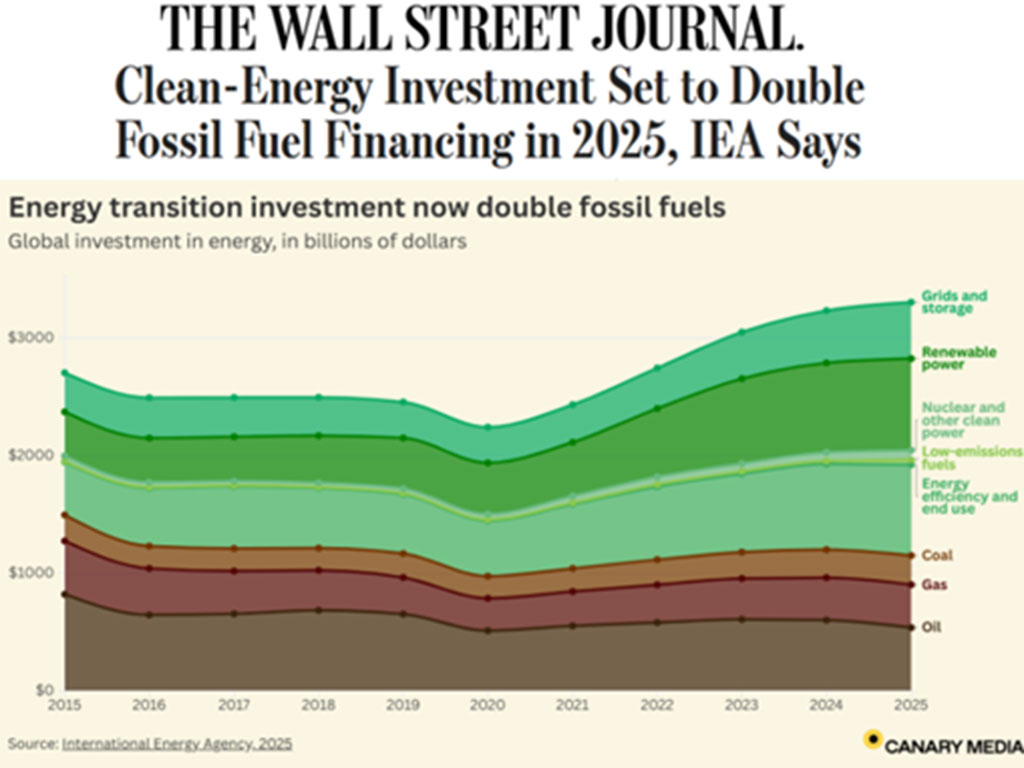
This is in large part because, with free fuel sources, renewable sources are less expensive to operate.
Nonprofits, including Citizens’ Climate Lobby (CCL), are boosting less expensive clean energy permitting reform, lowering the cost of electric bills, and defending key scientific research institutions, like the internationally significant National Center for Atmospheric Research (NCAR) in Colorado.
David Kunhardt of Scarborough is a retired solar executive and a volunteer with CCL.