Book Short
The Names
By Florence Knapp
By Stephanie Miller
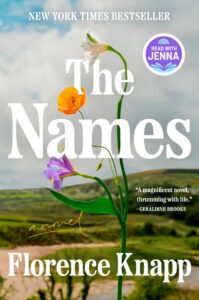
“The Names” by Florence Knapp asks the question: Can a name change the course of a life?
I’ve long been fascinated with “seminal moments,” those sometimes benign, often traumatic events in a life that catapult the person into the current version of their life. Humans do this all the time. We attribute a whole situation – happy or sad – to one moment like the proverbial butterfly wings fluttering down in Mexico that cause Canadian wildfires decades later.
Knapp’s novel “The Names” shows what one decision – the naming of her first son – does to Cora’s life. Over the course of 35 years, we see three alternating versions of her son’s life shaped by Cora’s last minute decision. Three names, three versions of a life, and the many possibilities that a single decision can spark.
The book is also structured around the fact that Cora’s husband is a manipulative tyrant who beats her. Those disturbing elements shape the entire narrative, and give a haunting, forever-present veil to the relationship between Cora, her son, and her daughter Maia, who is nine when her brother is named and already an expert at managing and diffusing the tensions at home.
I’m no psychologist, but it seems Knapp does a good job navigating the dimensions of flight, fight, freeze, and fawning that are typical reactions to trauma.
I found ‘The Names’ by Florence Knapp to be engrossing with relatable characters.
Even while deep into the story, I could pause and appreciate strong prose, incorporation of real events, and literary tactics like secondary characters who pop up in multiple versions. The latter makes sense. Just because I made a choice that steers my life in a new direction doesn’t mean that I won’t come across the same people in my life, albeit in a different relationship or with varying depth of connection.
As I got into the second section (broken out by five seven-year periods), I started to make a map. Under each of the son’s names (Bear, Julian, Gordon), I listed what was happening. What happens to Cora’s marriage? How does she manages her relationship with the abusive spouse? What careers do Maia and the son pursue? Who are their love interests, where do they live, and what are their joys and challenges? I liked seeing it all down on paper in an organized way to better appreciate what Knapp was building. But I also neglected it after a while because the story compelled me forward.
PS: From the “you should know” department
A study by the University of Sussex found that reading for six minutes reduced stress by as much as 68 percent, outperforming other relaxation methods like listening to music, drinking tea or coffee, or going for a walk. The study suggests that engaging with a good book can help the brain shift from emergency response thinking to rational thinking. This leads to a calmer state.
Micro Shorts
“Better Luck Next Time”
By Julie Claiborne Johnson
It’s the 1930s in America, and while most people are starving and out of work, some wealthy women are booking trips to Reno, where six weeks residency in “the divorce capital of the world” can free them from their latest ill-chosen spouse.
Twenty-four year-old Ward spent a year at Yale before his family lost everything. And so he’s working as a cowboy (mostly with his shirt off), helping the Flying Leap ranch cater to every whim of its divorcee clients.
Told in a series of his memories fifty years later, the novel winds around one fateful summer where Ward falls in love with one of the clients, Emily. Her daughter, who is determined to keep her parents together, plays the kind of cruel tricks that only a teenager could pull off. The tension ends in a painful parting and the launch of Ward’s future life as a successful doctor.
As the novel opens, we wonder who comes to visit an old man in a retirement home, holding photos of that long ago summer? This treat of a story takes you through several unexpected but delightful twists in the tale.
“On Looking, Eleven Walks with Expert Eyes“
By Alexandra Horowitz
In an exploration of how we experience and discover the world, Horowitz takes essentially the same walk around her Manhattan block with experts that range from her own toddler son to her faithful dog to experts in calligraphy/lettering, geology, sound design, and even urban sociology.
Each chapter starts with two quotes on seeing, including from Sherlock Holmes: “The world is full of obvious things which nobody by any chance ever observes.”
The author finds that she has been missing a lot. She writes, “Part of what restricts us seeing is that we have an expectation about what we will see, and we are actually perceptually restricted by that expectation.”
Horowitz calls it “intentional blindness,” meaning we miss things because they do not fit our expectations. It makes me think of the cinematic symphony that accompanies any outside walk, particularly in a cityscape. It surrounds us but barely touches us as we move through it, preoccupied with our own dramas and challenges.
The book ends with, “Do not reproach yourself for not paying good enough attention. There is no mandate, only opportunity. Our culture fosters inattention, we are all creatures of that culture.” If you want to better appreciate your surroundings, read this book, and then go for a walk!
“Ribbons of Scarlet, Stories of the French Revolution’s Women“
By Kate Quinn, Stephanie Dray, Laura Kamoie, Sophie Perinot, Heather Webb, and E. Knight, and edited by Allison Pataki
“This novel is dedicated to the women who fight, to the women who stand on principle. It is an homage to the women who refuse to back down even in the face of repression, slander, and death. History is replete with you, even if we are not taught that, and the present moment is full of you – brave, determined, and laudable.” (From the epigraph)
This is the coolest of collective novels, where a group of fabulously successful women authors of historical fiction weave together stories of women mostly erased from history.
We meet: The Philosopher, The Revolutionary, The Princess, The Politician, The Assassin, and The Beauty. Together, it shows how women, in the era of the newly minted guillotine, played a significant role in the revolution, preservation, and re-imagining of France as a democracy where wealth was more evenly distributed and peasants were given rights and agency over their own lives.
It’s a lively portrait of how change happens in real life: messy, long, harsh, deadly, inspiring, horrifying, and heart-rending.
The “politician” Manon Roland is quoted, “It is easier to avoid giving a man power than to prevent him from abusing it.”
She was my favorite of the lot. In the eighteenth century she chose to become a politician’s wife, which was the next best thing to being allowed the role herself. Her position was both glorifying and frustrating. She wrote the speeches, drafted legislation, and crafted policy for her spineless statesman of a husband. In defense of his lack of any personal commitment to the new nation, reportedly he killed himself. He did so while in exile a few days after Manon was executed, despite his lack of action during the long months she spent in jail on his behalf.
On the other hand, she took time when she was in prison to grasp a kind of freedom and finally wrote her own story under her own name. Friends smuggled out the parchment rolls under petticoats and inside umbrellas. It was ultimately published posthumously.
In her last days, she contemplates her last words as she mounts the scaffold: “Liberty. What crimes are committed in your name.”