The good reasons to make streets safer for pedestrians and bicyclists run the gamut. Myles Smith, with Mainers for Smarter Transportation, says crime would decline with more people on the sidewalks. The City would have a better shot at its One Climate Future goal of fewer driver miles, and thus less pollution. And, perhaps, the chicken would be able to cross the road in one piece.
Pedestrians in Portland encounter many street crossings that seem like a game of chicken. Six pedestrian fatalities between October 2024 and February 2026 make clear it’s not a joke.
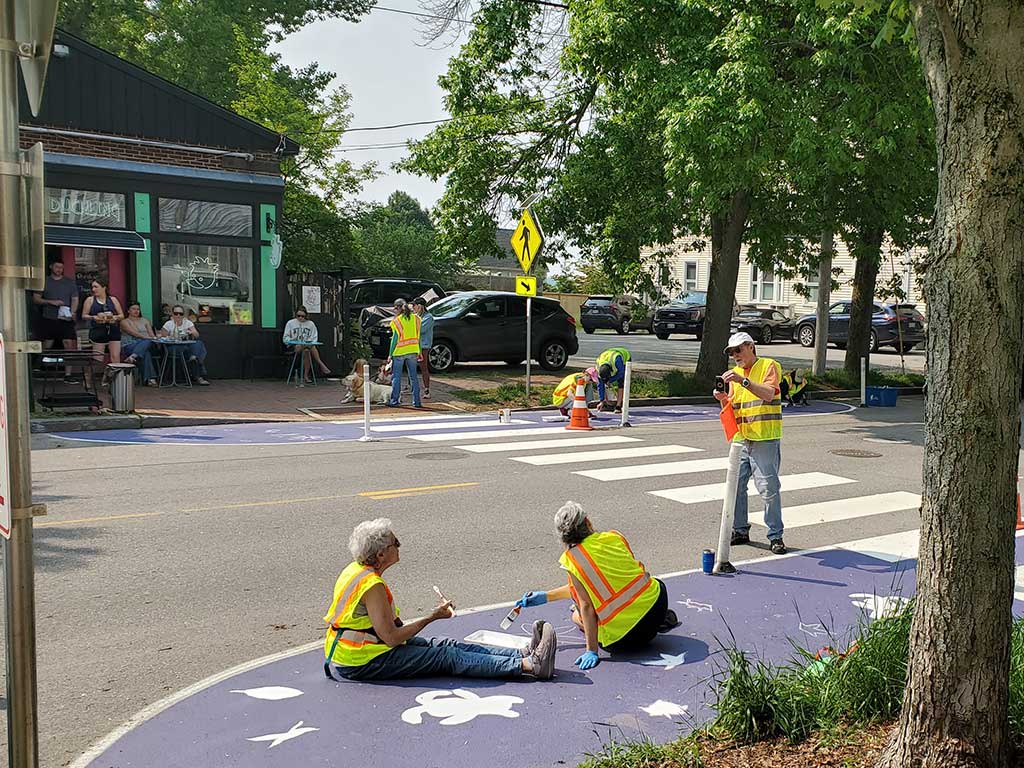
Crosswalks are a central theme of increased pedestrian safety. Gregory Farino, who has worked with the West End Neighborhood Association on many traffic calming projects, helped put together a neighborhood-installed crosswalk at Park and Danforth streets to help people cross. He had already observed, with a helper, how few cars would stop for a pedestrian at the curb.
“At Park Street, 90 percent of the pedestrians would not start across the road until the cars were gone,” he said. After his community group painted a crosswalk at the intersection, he said nine out of ten cars did stop.
New Crosswalks – Easier said than done
Jeremiah Bartlett, Portland Traffic Engineer, said the City would not install new crosswalks without ADA compliant curb-cuts. This requirement keeps new permanent crosswalks on hold awaiting capital improvement projects.
But the Public Works Department is working on improving what Bartlett called “high risk, high injury corridors,” like Brighton Avenue and Franklin Street. A federal Safe Streets for All grant of more than $2 million will restructure around one mile of Brighton Avenue from I-95 to Wayside Street, near Capisic Pond. Bartlett anticipates that the redesign to three lanes will make it easier for pedestrians to cross Brighton Ave.
In 2028, Maine Department of Transportation plans to fund a “mill and fill” repaving on Brighton from the roundabout to Taft Avenue, also by I-95. “That’s the biggest project I’ve seen,” Bartlett said. It has just been published in the MaineDOT work plan. The project would include new crosswalks in hard-to-cross blocks, especially east of Capisic Street.
Slow Down – 20 is plenty
But another idea would get us across a street far more easily, and there would be no wait for money to arrive from the state and federal government.
“Twenty is plenty” is the motto of traffic safety advocates of all kinds. The phrase was on hand-painted signs put up around the West End last year. Smith referred to the Global Alliance of Road Safety to report that reductions in speed limits to around 20 mph had made Boston, Madison, Wisconsin, and Wales places with far improved pedestrian safety.
Anyone can take this choice into their own hands now. A pedestrian has the right of way whenever in the crosswalk. If drivers are traveling at 20 mph, then it is easier to stop in time. Plus, if struck at slower speeds, the likelihood of injury or fatality to the pedestrian is far lower. According to the European Transport Safety Council, 5% of pedestrians struck by a vehicle at 20 mph are fatally injured. This likelihood increases to 45% at 30 mph, and 85% at 40 mph.
Traffic Calming – Making temporary efforts permanent
Traffic calming installations have been popping up around Portland since at least 1999, according to Farino. Painted “bump-outs” rimmed by plastic bollards that bend if hit, with bright and highly visible colors, work by narrowing streets to help slow traffic.
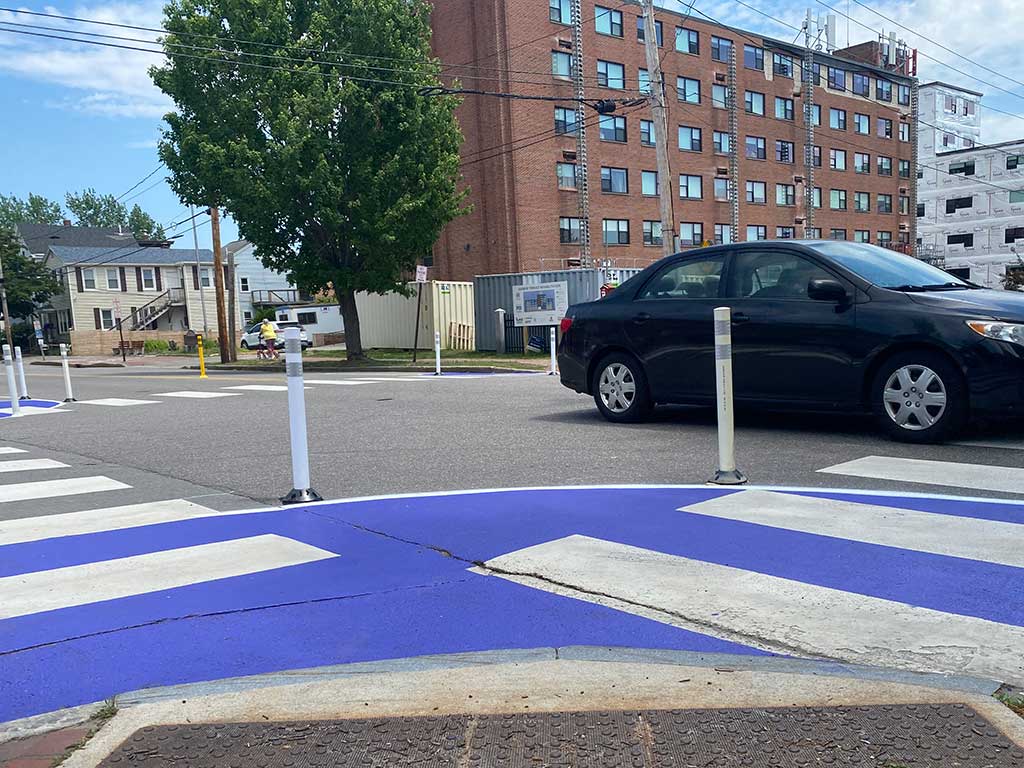
But they are seasonal only and need to be repainted and reinstalled annually.
At a Traffic Calming Workshop held at Reiche Community Center, led by Farino in late January, there was general agreement that the neighborhoods that have repeatedly installed traffic calming projects should be able to make these projects permanent. On Danforth Street in front of the Ugly Duckling and many other places, bump-outs and painted crosswalks have proven their value with measured reductions to traffic speeds, according to Farino.
The City is currently identifying places where four-way stops could go, including Franklin and Commercial streets. The “barn dance” four-way red signal at Park Avenue and Deering Avenue is one example.
Bartlett said the City is considering adding more no-parking space next to intersections to extend visibility. The City’s current requirement is no parking within 25 feet of the intersection.
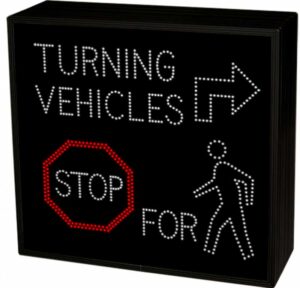
Automatic pedestrian crossing signals could be added at many more city intersections. The “begging buttons” as Smith calls them, could augment safety by offering a longer pedestrian light. Of course, many visitors do not know that without pressing them no pedestrian signal will be given.
“We don’t reward people for walking,” Smith said. “We actually punish them.”
Right on red is another feature of car-centric traffic design that Smith recommends ending. Right on red is illegal in New York City, where pedestrians enjoy high priority. Ultimately, at a busy intersection, the combination of right on red and go on green can mean a pedestrian never has a chance to cross.