LAYNE’S WINE GIG PRESENTS
NAVIGATING GLOU GLOU
By Layne V. Witherell
Glou glou (as in “glug glug” or easy-drinking wine) is but one of those delightful semi-descriptive terms you may hear when you visit a “natural wine” shop or wine bar. Others can include artisanal, rustic, purposefully archaic, boho label, and my personal favorite crushable. Language that a new generation has invented to describe the indescribable.
“Orange wine” is the term de jour. Producers macereate (or soak) white grapes like they would with red wine creating an orangish color. Or as the winemakers say, “We prefer to call it an amber wine, you bozo!”
Flavors are tough, but when the wine is made in a yurt using no modern equipment, relying on unpredictable natural yeast, and with questionably sanitary conditions the flavors can emerge as feral, with flaws as attributes, and a snap of acrid smack. They can be “a fantasy of marginal producers” as French wine critic, Michel Bitane once said. Or as Ray Isle of Food and Wine describes them as “the unwashed feet of French hobbits.”
In essence “natural wine” replaces technical consistency with mystical wine making. Or, in other words, it challenges our way of life as we know it, in this chemically dependent universe. The dowager queen of natural wine, Alice Feiring of New York City has written, preached, and prophesied against “industrial” wine for over twenty-five years.
I must confess, for over twenty years I have considered their entire crusade as “voodoo making a remarkable comeback.” Recently however, I have discovered some delicious, not over the top wines appearing in “regular” stores and on wine lists with just enough funk to make them fun. Let’s take a look.
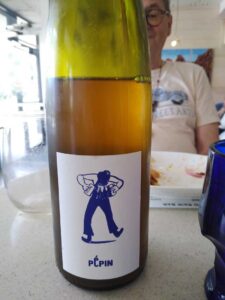
Pepin Gewurztraminer, Alsace, 12 % Alc., $16.00 Glass, $39/bottle
Ironically, it actually says “orange wine” on the back label.
Listed as a Gewurztraminer, it is a blend containing Sylvaner, Pinot Gris, and Auxerrois. Land in Alsace is expensive which excludes one of the back-to-rustic tenants of natural wine. Also, the place is awash in technology, as well as lab cultured yeast (a definite no-no with the glou glou inclinded).
There is a hint of wildness, but there isn’t a bold, over the top guava and lychee character of the grape here, nor is it feral. This is what I call the Gen Z relaxed version of natural wine.
Great with shellfish, especially live scallops at SoPo Seafood in South Portland, where it appeared on their list.
Grape Abduction “Orange Wine”, 2024, Slovenia, 11.5% Alc., $17.99 / 1 liter
Pinot blanc, Riesling, Gewurztraminer, and Chardonnay blend. Slovenia has 28,000 wineries with 40,000 growers who export but a mere 5% drop of their production. I admire their quirky attitude.
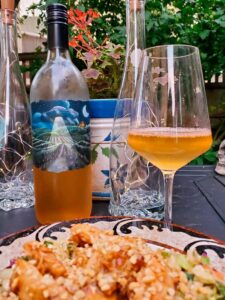
The flying saucer, seen through a clear bottle with a thorough orange background tells all. The beauty of this wine is that it is both food friendly and a wine that you seriously ponder.
The general thought in what I affectionately refer to as Glou Glou World is that obsessing over food and wine combos really doesn’t matter. So, we paired this wine with Judy’s grilled chicken over crunchy Asian slaw salad with a Thai peanut sauce resulting in a totally memorable dinner.
Clos Hirissou, Pet-Nat Rose, Gaillac, France, 11% Alc., $21.99
Okay, now it’s time to go all glou glou on you. Nothing spells slurpy natural wine like a pet-nat. This one has all the requisite stuff: boho label, natural yeast, emotional, rustic, and feral.
Petillant-Naturel kind of makes itself. You just let the wine partially finish fermentation, put a crown cap on the bottle, and make sure you are growing a funky grape like Mausac in an off the beaten path wine region. And then you have a natural wine bar celebrity.
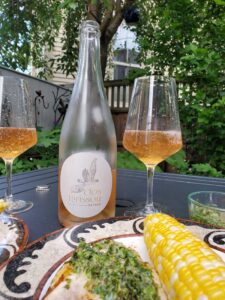
Gaillac as a wine region predates the Romans, but had the great misfortune of being located in between Bordeaux and her favorite customer, Great Britian. Can you spell punishing tariffs?
The Mausac grape has an apple peel style flavor and even the glou glou people can agree that this is a fabulous pairing with either popcorn or buttered corn.
After much trial-and-error Nicolas Hirissou has managed to turn an obscure grape and region into a wine that can be enjoyed by both the natural wine set and the Ray Isles of the world.
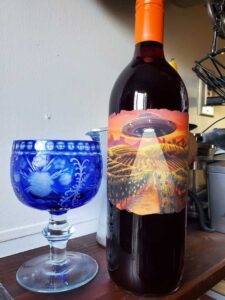
Grape Abduction, Slovenia Red Wine, (Blaufrankish), 11.5% Alc. 2024, $17.99 / 1 liter
Blaufrankisch (pronounced: blau-frank-ish) has a problem. As a grape, it has several problems. But foremost, the spelling and pronunciation make you simply wish this astonishing vine – that grows in Austria, Slovenia, and occasionally America – was simply called pinot grigio and left alone to prosper. It needs recognition.
Although history is sketchy, we can trace the grape to (who else?) the Romans, and then it makes a mystery reappearance via Livtgard, the wife of his highness, the emperor of all of Europe, Charlemagne (768-814). It was thought during this time to be a “noble grape” much like Pinot Noir or Chardonnay. Say, the Bordeaux or Burgundy of its day.
So, what happened? The big one happened. WW1 turned its home of Austria and Slovenia into the land of forgotten grapes. Also, there was a ghastly wine scandal that I don’t have the room to go into here.
Fast forward to the natural wine, glou glou people of today. They adore the grape for many reasons. It is low in alcohol – definitely part of their aesthetic. In the vineyard it can be pruned to a very low yield per acre to produce an intense wine loaded with color and tannin. Or it can be allowed to reach an astonishingly high 7.5 tons to the acre and produce a slurp fest of a glou glou in the form of red, rose, or pet-nat. Take your choice.
This Blaufrankish has flavors that are right in the middle. A touch of funk without the acrid smack and flaws as attributes.
Like a darkish orange wine to think about and have with some serious protein on the plate. Among the food recommendations are lamb, veal, game and game birds, ostrich (I am not making this up), hard cheese, and creamy sauce.
The things that appeal to the glou glou enthusiasts are present: rustic, boho label, emotional, and artisanal. It is way sustainable, and being rediscovered as a grape – like the great-granddad of Cabernet Franc.
Here’s the rub.
I mentioned a problem. The name isn’t going to sell. The other great Austrian wine Gruner Veltliner simply got nicknamed “Groo-Vee” in the mid 90’s. Now it’s everywhere.
Austria and Slovenia could have a “grape nicknaming” contest. Maybe a little Mendo Blendo could be in order. A splash of Cabernet Franc or Pinot Noir to adorn the label for an extra bit of complexity alongside that all important name recognition. They tried naming the grape Lemberger in Washington State – to no avail.
The other problem is cost. The wines in this article are available locally and are affordable. Moving up the ladder of Blaufrankish is tough in Maine. Roland Velich’s great winery Moric was discontinued by the distributor some time ago. His Reserve wine is on the wine list of Bayona in New Orleans for $140 per bottle.
I guess that you could call this glou glou and life beyond glou glou. Natural wine is clearly getting calmer in its middle years, as it appears on both regular wine lists and stores. Worth seeking out? Use your wallet as a guide.