

Michael Connolly: Historical Fiction from Portland’s Working Waterfront
Every month, Liz Trice interviews a community member for The West End News. This month, she caught up with Michael Connolly, a historian living on Munjoy Hill who just published the third part of a trilogy of novels based on three generations of the fictitious Folan family in Portland.
How did you come to write historical fiction about Portland?
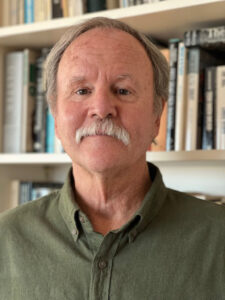
I taught as a professor of history for 36 years at St Joseph’s College, and wrote three history books on John Ford, Portland’s waterfront, and Irish immigration into Maine. I retired in 2020, and only then started writing these three historical fiction novels.
The stories are roughly about my family. Both sides of my paternal family were immigrants from Galway, Ireland starting in 1880. My grandfather was a charter member of the Portland Longshoremen’s Benevolent Society, which later merged with the International Longshoreman’s Association.
The books tell the story of an Irish longshoreman starting 1900, living in Portland together with his wife and nine children – with another on the way! “Murky Overhead” tells the story of a family for whom life is precarious – the longshoreman also has issues with alcohol. That novel has sold over 1,000 copies and has been warmly received by the Irish community in Portland.
The second, “Ever the Twain Shall Meet”, takes place in the 1930s and 40s, and is about an Irish man who married a Yankee Protestant woman – what was then called a “mixed marriage” – which was frowned upon at the time.
This final one, “As the Twig is Bent”, occurs in the 1960s and 70s. All three are published by Tower Publishing in Standish.
What is a longshoreman?
A longshoreman is a dock worker. They take various products to or from a ship and prepare it for further transport. At Portland’s International Marine Terminal, the International Longshoreman’s Association still works – only now with containers.
In 1853, Portland was first connected to Montreal by rail, which allowed grain from the Canadian prairie provinces to be shipped from Portland to Europe during the winter months, when the St. Lawrence River was frozen. At the high point, there were over 1,300 longshoremen working in Portland.
Those pilings still sticking out of the water on the Eastern Waterfront today are the last remnants of the docks which served the Grand Trunk Railway, otherwise known as Saint Lawrence & Atlantic Railway. That trade flourished until 1923, when Canada decided to ship its grain out of its own ports of Halifax and St. John – thus providing work for Canadian workers.
After 1923, the trade with Canada diminished. The number of longshoremen dropped from 1,300 to only a few dozen by the 1980s. But Governor Joe Brennan – whose father was an Irish longshoreman – promoted the re-building of the International Marine Terminal. So when Eimskip came looking for a North Atlantic port close to Iceland, Portland was ready.
It’s a major source of income for the region now. Companies such as LLBean can ship efficiently and directly to Europe, and Maine natural resources such as apples, potatoes, and lumber also ship out. It’s much cheaper and environmentally conscious to ship by container. A lot of frozen fish and other products from Europe come in through Portland to serve the whole country. The waterfront in Portland by the mid-1900s was fairly derelict and hardscrabble, showing many signs of widespread poverty. All that has dramatically changed.
How did you research the books? What are some of the stories?
I read ninety volumes of Longshoremen’s Association logs, records which were kept in the Labor Temple – what’s now the second floor above the restaurant The Corner Room on Federal and Exchange Streets. And I interviewed dozens of people, mostly in their 80s, who had been longshoremen. And I added the stories I had heard from my family.
In 1920 -1933 we had Prohibition in this country. So you couldn’t buy and sell alcohol openly, but wealthy families could still buy “bonded” alcohol for “medicinal purposes.” One day a longshoreman supposedly broke his leg working on the waterfront while they were unloading medicinal alcohol. Even though there was a sheriff overseeing this work, when they sent the ailing longshoreman to the hospital, they snuck two cases of bonded Scotch Whisky off the docks under his gurney. Stories like this were repeated over the generations.
It was very dangerous work, and several members of my own family died or were severely injured while working on the waterfront. Some people got crushed under heavy loads, some fell into the ocean in the winter, some even died by fire. The union had death benefits and sick benefits which could last up to ten weeks. This was before the federal government created benefits such as Social Security starting with the New Deal of the 1930s. The benevolent societies and early unions essentially pulled together people in the same industry or job to help each others’ families in their times of need.
You’ve lived your whole life in Portland? How does having so many generations of your family affect your life today in Portland?
I’ve lived in Portland my entire life except for when I studied away at college. I was in Florida for three years, got my Masters in Modern Irish History at University College Dublin, and finally a Ph.D. in immigration history at Boston College. Portland was started by families with English Protestant roots before the arrival of the Irish and then other non-Anglo-Saxon groups including Italians, French-Canadians, and Russian Jews. These groups made slow and steady progress.
The Irish men got jobs on the waterfront and in construction, while Irish women worked as domestics and later at the telephone company or as teachers. That’s why the story of Joe Brennan is so interesting. His father was a Gaelic-speaking dockworker, and his son became a two-term governor of Maine – all in one generation!
Your book signing event is Oct. 16th at the Maine Irish Heritage Center at 34 Gray Street in Portland.
Yes! From 6:30 to 7:15pm will be book signings, followed by a powerpoint presentation. There will be traditional Irish music, along with some readings from the book. Half the proceeds will go to support the Maine Irish Heritage Center.
FMI
Maine Irish Heritage Center – https://maineirish.com/
Buy Michael Connelly Books: https://tower-pub.myshopify.com/search?q=connolly
This interview was edited for clarity and brevity.






One Comment
David Myers
I am quite sure that Michael and I have a strong history working together at a camp in Winthrop in the mid to late 60’s. Would love to get together with him. I am semi-retired and living in Damariscotta. D Myers