Makers Share their Skills at Factory 3
By Nancy English
When Patrick Russell decided to start Factory 3 in 2017, his goal was to create an affordable place for crafts people to do their work in Portland. He bought the building at 103 St. James Street in 2021.
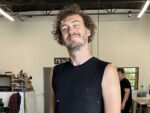
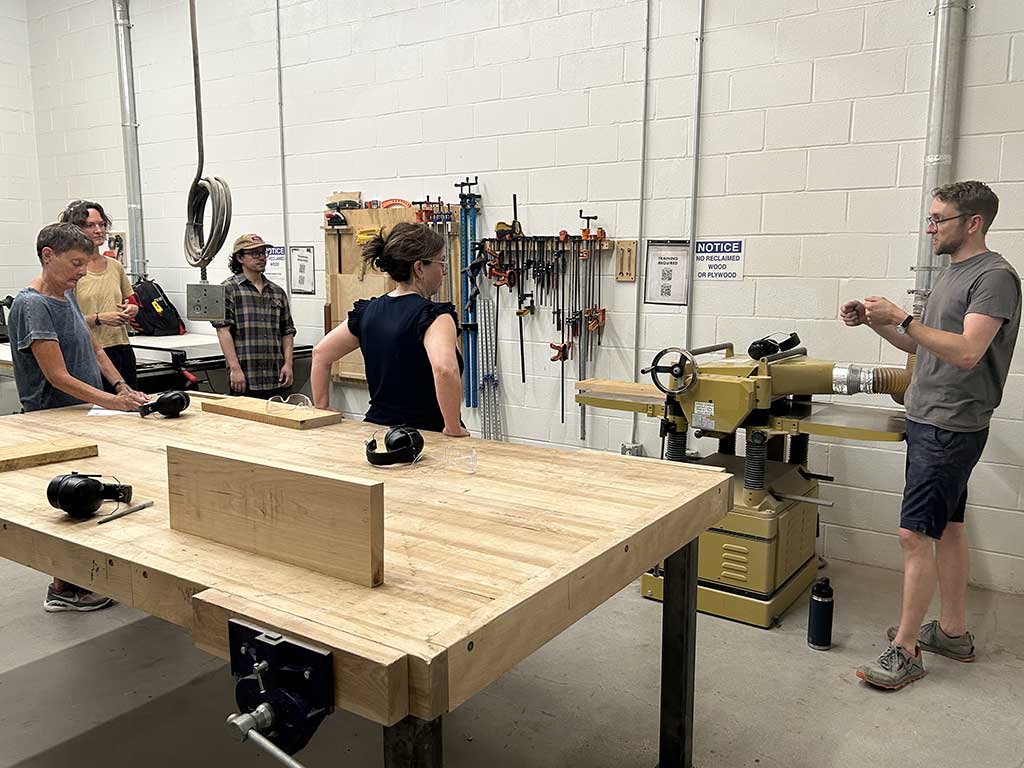
“From 2014 to 2021, creatives were being pushed out of the city,” he said, as he showed off the array of equipment his maker space holds inside its warehouse walls. He found much of the machinery online, slightly used. Now, dozens of Factory 3 members and class participants get to build skills using a planer, a bench drill, or a metal inert gas welding tool.
A new air compressor and a plasma cutter that’s like a “light saber,” he said, will be part of the available machinery soon.
In Welding 1, students can learn how to create clean weld beads for about $180. Factory 3 offers the 3.5-hour class two or three times a month. “Factory 3 has taught over a thousand how to weld,” Patrick Russell said.
Successful Crafters Get Their Start
Ten members and former members of Factory 3 have gone on to establish their own studios or businesses. Underdog Candles’ owner Lauren Chunias, underdogcandles.com, offers her own classes in Westbrook, but a membership at Factory 3 came earlier.
Woodworker Evan Mullin, evanmullinfurniture.com, has a workshop in Biddeford now, just off the highway on Elm Street. He is thinking about taking the welding class to add metal components to his work.
“Factory 3 was a useful middle ground instead of starting my own shop,” Mullin said about his membership that he began in 2025, while still employed at a woodworking business not his own.
“I was mostly working on projects for my own house.” One of those projects was a coffee table that he made entirely from the same piece of wood. Using a single piece of wood allowed the “waterfall grain” of mitered corners that wrap its edges.
Beginning with Family
Patrick Russell learned woodworking as a teenager by building fences and chicken coops on a farm in Ipswich. Today, his family is all in with a shared love of handcraft.
His dad, Ted Russell, whose woodworking shop introduced Patrick to some tools, comes to Factory 3 to help with the business. His mother, Margaret Russell, keeps a weaving studio at Factory 3. Patrick’s sister paints in a studio among the cubicles in the middle of the warehouse floor.
Margaret Russell also teaches weaving at Factory 3, offering monthly four-hour classes with several four-shaft table looms prepped for her students with fiber included.
Others teach the art of making crochet lace, or darning, mending, and hand embroidery. One member builds satellite parts. Still others make things in the 3-D printer, which was stirring into action as we watched. During the pandemic, Patrick used it to make full-face masks with an internal fan.
“Seventy percent of the members live on work done here,” Patrick said. Monthly paid memberships, allowing use of the facility daily from morning to night, sometimes become available.
Popular Classes Build a Foundation
The lathe-turning workshop is sold out for August, but classes in the fall are still open for first-time bowl makers. Taught by Paloma Días-Dickson, this three-hour class meets three times over three weeks. “People are surprised when I tell them you are going to walk away with two or even three finished bowls.”
Maple “bowl blanks” are included in the $440 fee. They are dried to retain the right amount of moisture when turned on the lathe. Días-Dickson learned this craft at Factory 3 herself, with a first class in January of 2024. “I kept going and taught myself a lot. When the teacher who taught me stepped down, she recommended me.”
Jillian Carrozza teaches a monthly fourth-Sunday, four-hour class on sewing. Her training at the Fashion Institute of Technology in New York led to further studies at Central Saint Martins College of Art and Design in London, England. A knit design she created there brought her an internship with John Galliano, then creative director of Dior, in Paris. “One of the best times of my life,” she said.
In her intro to knitting class, she said, “You learn to cast on, knit, pearl, and cast off. It’s only these two stitches that are the foundation. It’s like learning the alphabet. Look at all the words you can make!”
Her love of fiber informs a whole philosophy of life and gives her website, fabricphilosophy.com, its name. “Yarn is called energy. It has to have a twist, like the turn of the earth, or the spiral of a seashell.”
Hand work will remain a focus as Patrick Russell contemplates expansion, possibly upward. Meanwhile, rewarding work awaits anyone with the fee and curiosity about what their hands can accomplish with tools, materials, and time.