Layne’s Wine Gig Presents
Wines of Spain – Old & New
By Layne V. Witherell
There is a lot going on in Spain, both modern and ancient in a land of passion, tradition and innovation.
Nessa Albarino, Rias Biaxas, 2024, 13% Alc. $17.99.
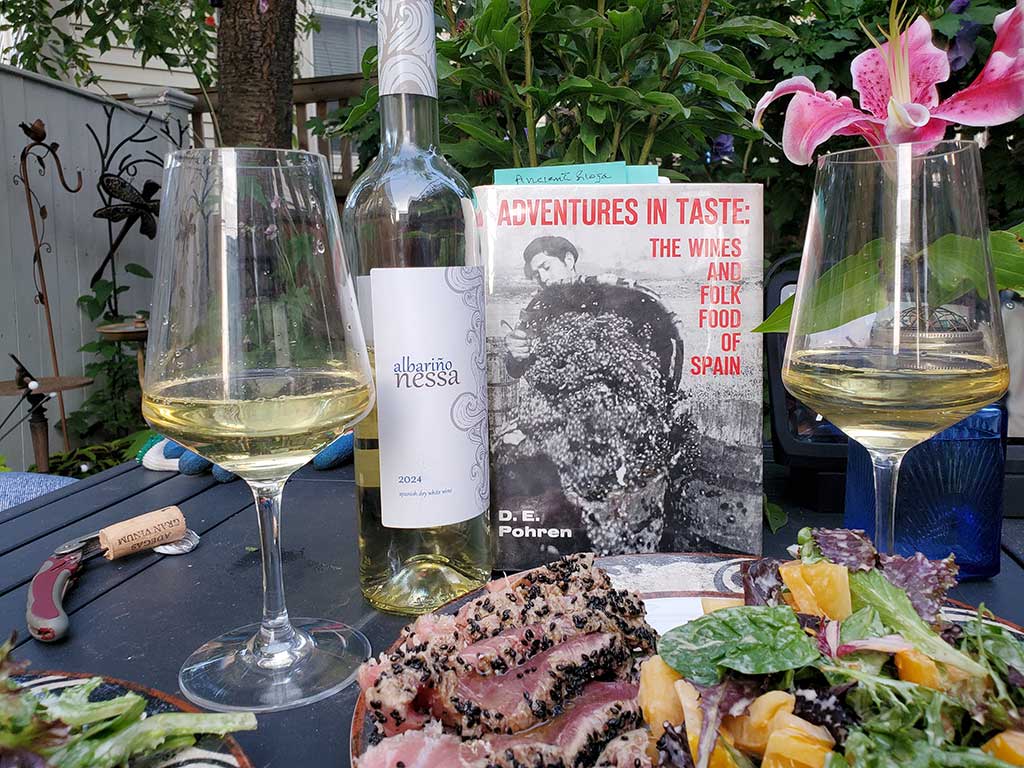
By Spanish standards Albarino is a recently discovered grape with plantings in its home in Rias Biaxas, the far north of Spain, rising exponentially year by year based on its growing popularity. The grape has expanded from less than 500 acres in the 1970’s to 3,700 acres in the early 1990’s to over 10,000 acres today… and still growing.
Let’s hear it for modern technology, producing a young, fruity, fleshy, zesty wine that is an ideal accompaniment to local (or not so local) mussels, octopus, roast veggies, paella and soft cheese.
Our favorite, per Judy’s photo, is fresh tuna steak, sashimi or lightly seared. The book is a Spanish classic by D.E. Pohren (American ex-pat) “Adventures in Taste: The Wines and Folk Foods of Spain”. Lots of local restaurants feature the grape. Surprisingly, the Bissell Brothers outpost at Thompson’s Point (appearing on their tiny wine list) is one, and Mr. Tuna’s Sake centric list has got it. The Albarino with freshly caught tuna sashimi is brilliant.
The problem with Albarino, as with anything that becomes ungodly popular, is what I call “the lobster roll effect”. Every national food and wine mag needs a story, either real or just culled from their clip file. Are you listening, New York food writers and wine bloggers?
There is great stuff and the not-so-great stuff. Not to be confused with Alvarinho, the wine of Vinho Verde, a light, low alcohol, high acid, slightly fizzy white from Portugal that is okay in a pinch but not the real thing. For me, a good guide are two high quality Spanish wine importers, Fran Kysela or Jorge Ordonez, will be listed on the back label.
Lobetia Tempranillo “Vegan and Carbon Conscious”, “Made With Organic Grapes”, Vino De La Terra Castilla, 13.5% Alc. $10.99.
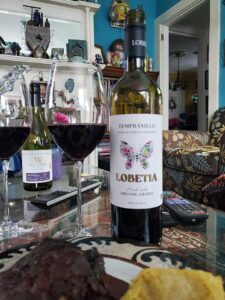
This wine proves several things. First, there is lots of room on front and back labels for a whole lot of politically correct jargon. Second, you can get a good Spanish wine for not a lot of money. Third, and most importantly, Spain is all about the old and the new and this is a prime example. It is a classic of the “hey, we made it baby” syndrome – complete with the addition of a mystical butterfly on the label.
Well, actually they did. Prior to the 20th century this was a leather-goat-skin-strapped-on-the-burro-while-herding-the-shepherd’s-flocks kind of wine. Occasionally, and I mean occasionally, these were the wines of the local wine bars (see Casa Pablo for a local look). The usual urban sprawl interfered with shrinking the vineyards, and there wasn’t a lot in the future until the Spanish government, because of the locals six-year campaign, awarded the region a Denomination of Origin (DO).
The Denomination of Origin is the academy award for a local wine. In the case of this wine, it is good in boosting both local investment and self-esteem. Lobetia pairs especially well with Manchego cheese or a veggie burger on the grill. Their grape, Tempranillo, resembles flavors that resemble Pinot Noir, but just a touch more rustic. Just reading and thinking about the label makes me feel better already.
Flor De Zalin (Red Blend), Montsant, 2021, 40% Carignan, 40% Syrah, 20% Grenache, 14.5% Alc. $12.99.

Montsant was previously part of Tarragona and the wider region of Catalonia in Northeastern Spain. They take their new name from the Montsant mountains in the region. Their moment in the sun was around 218 BC when founded by Publius Scipio with visits from the Roman emperors including Augustus and Hadrian, both who came to build as well as reside. There is an amphitheater that can hold 12,000, as well as a really nice aqueduct. Their local wines were shipped to Rome with much applause and adulation.
Fast forward several thousand years and things weren’t going so well in the region. The wines were sweet, shipped in bulk, and had few customers. The Brits with their love of treacly stuff kept a co-op or two barely alive.
Then came NEW GRAPES! This is truly a “new age” blend. Don’t let the 14.5% alcohol scare you as it is soft and lovely, having its own elegance alongside Judy’s Peruvian grilled chicken and creamy green sauce dish. The grapes offer up a classic “Mendo Blendo” (see Layne’s Wine Gig online) as they mellow out the wine. Carignan is usually always blended to provide that soft, velvety flavor. Way to go.
Faustino Crianza, Rioja, 2021, 14% Alc. $17.99.
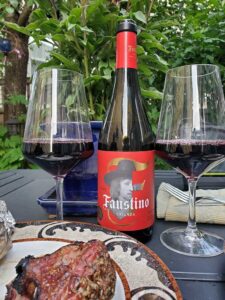
No region in Spain is more hidebound to tradition or is undergoing more revolutionary change than Rioja. It comprises three large grape growing areas: Alavesa with 24,000 acres, Alta at 50,000 acres, and Baja with some 37,000 acres. They are a presence on the world’s wine stage. The French came down here in the 1850’s when the awful bug phylloxera ate their vineyards.
Then, there are the rules. They have been in force for ages, and are currently under assault. Rioja falls into distinct categories for red wine (not much white is produced). Let’s look at Faustino, an old and venerable estate circa 1860. Everything depends on time spent maturing in barrels.
- Crianza – 1 year in wood minimum, 1 year in bottle minimum, $17.99.
- Faustino V11 – 1 year in the bottle, $14.99.
- V Reserva – 2 years in wood, 2 years in the bottle, $21.99.
- I Gran Reserva – 2 years in oak, 3 years in the bottle, $37.99.
All wines must be sold in the bottle with no bulk shipping allowed. Bottle aging laws are per bodega with no single vineyard designations permitted. Each barrel is computer tracked and 20,000 casks are in their cellars, with American oak as the barrel of choice. The principal grape is Tempranillo – always has been, always will be.
The Controversy
Since they are governed by the toughest wine rules in Europe, vineyards are trying new things. Let’s take a look.
- Yield per acre: Experiments to change and lower the yields.
- Minimum alcohol levels: Experiments to lower alcohol by harvesting earlier.
- Those dreaded barrel aging requirements: They are shipping older wine to a world that increasingly wants younger wine.
- Women in power: A woman has, for the first time ever, assumed a major leadership role in the Rioja wine industry.
How They Taste
Actually, very good. In an era when oak is used more as a condiment (think Napa and Bordeaux) the flavors of a mellow, aged Rioja are a refreshing change. Bottle bouquet (a word that we haven’t heard for a while) versus a primarily fruit flavor from wine that was smothered in a barrel of brand-new oak and bottled yesterday. It is best to check the age of the vintage. In this case, it is 2021, with lots of bottle bouquet and a soft whisper of oak from those 20,000 older barrels.
Spain is about food and wine. Plain and simple. Rioja is all about lamb chops or your best fillet on the grill to accompany that 14% alcohol.
In conclusion…
Spanish wines are having a moment. Whether it is the luscious Albarino with seared tuna, calamari, or paella; the Lobetia for your vegan pals, along with a little veggie burger or kale salad; or the Flor de Zalin and the Manchego cheeseburger on the grill. They are all here. Take your pick.
Layne’s Wine Gigs
Individually tailored gigs for small or large groups. Pick the place and the theme, and I will help you select the wines and provide the fun. E-mail me @ lvwitherell@gmail.com.