
Kip DeSerres: Unearthing Stories in the Western Cemetery

Every month, Liz Trice interviews a community member for The West End News. This month, she caught up with Kip DeSerres, Vice President and Tours Coordinator for the Stewards of the Western Cemetery.
What should everyone in Portland know about the history of the Western Cemetery?
It was the only public cemetery between 1830 and 1852, when Evergreen opened. Ninety percent of the people in the Western Cemetery were buried in the 1800s.
The largest single group that’s buried here is the first wave of Irish immigrants in the 1840s and 1850s, who came here because of oppression and unjust policies which resulted in famine in Ireland. Very few of those stones are visible, so we have a stone memorializing the Irish as a group. It’s a large black headstone that says “An Gorta Mor,” which means “The Great Hunger” in Irish.

Many people in the cemetery died from infectious diseases which were rampant in the 19th century – typhoid, diphtheria, measles – before we had antibiotics, vaccinations, and modern sanitation. Almost half the people buried in the cemetery are children, and 20% of people in the cemetery died from tuberculosis. There are whole families where children predeceased their parents, which for me makes it all the more important to tell their stories, because they don’t have any descendants. Whole generations were wiped out due to infection which we can now prevent.
What do the Stewards of the Western Cemetery do?
The Stewards of the Western Cemetery care for the cemetery, restore the headstones, and tell the stories of the people who are buried there. The cemetery was neglected for over one hundred years, and in 2000, a group got organized to start restoring it. Of 6,000 people buried in the cemetery, we know locations of only 3,000 of them, and only 1,500 headstones are visible. There was a lot of vandalism, and the acid from the dog urine over the years had eroded the bases of the headstones, and many have fallen over, been cracked, buried, or stolen. Eventually the city banned dogs due to the damage caused by dogs, and a new group organized in 2021 to clean and renovate the stones.
Every Saturday we have a crew that comes and does stone restoration. We restore 100 stones per year. On Sundays, I and three other people provide tours. We research the history of the people buried here and tell those stories so they’re not forgotten.
We are currently almost done raising $250,000, that will be used for several major projects: a fence all the way around, rebuilding a toolhouse that burned down one hundred years ago, and building a walking trail on the far side of the Western Prom road. To make a donation, go to our website, www.westerncemetery.me.
How do you restore a headstone?
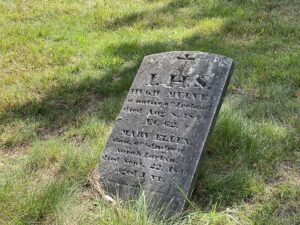
First you have to find it. Sometimes they’re lying flat on the ground. So you have to pick it up and find or make a stand for it, and clean it. Sometimes they are broken into pieces. Then you epoxy them together and fill it with a material called Lithomax, which looks like the same white marble as the stones.
The oldest stones are slate, then people started using marble, which is easy to carve by hand, but easily erodes. Then people switched to granite once power tools were available.
How did you get involved?
My undergraduate major was in history and I have a master’s degree in public health. I was the vice president for the American Cancer society, doing patient education and services, and worked for the Maine CDC during the pandemic. I know Jonathan Monro, who works primarily on restoration, said he wanted someone to organize tours. I’m trained and on the faculty of the Maine History Docent Program, so I’ve been involved for 2 to 3 years.
How do you find the stories?
Findagrave.com allows you to identify where people are buried, and attach stories. I look for census records, obituaries, and other public records.
Tell me the story about the “witches grave”, the Longfellow Tomb, and other special sites in the cemetery.
The grave known as the “witches grave” has an unusual design. It looks like a dark colored above ground casket with inscriptions in Latin. It’s actually for a young priest who was born in Portland but died of tuberculosis while in England. He was returned to Maine in a carved wood coffin, and people decided to make a replica of the coffin in stone as a monument.
The Longfellow tomb is one of the tombs built into the hillside below Bowdoin Street. Samuel, Henry Wadsworth Longfellow’s brother, and Henry’s parents, were buried here. But in 1986 the tomb was opened and found empty, and we have no idea where the bodies went. It’s possible that a family member intended to have them shipped elsewhere and got lost, but there’s no records.
John Neal is buried here. Neal Street was named after him. He was a real renaissance man. Neal opened the first public gymnasium founded by an American in the US in 1827; he was an advocate for equal rights for minorities and women, and ended his relationship with the gym a year later when the members would not support his nomination of African-Americans for membership. He established gymnasiums in other Maine cities and taught boxing and bowling at Bowdoin College. He also built the four story grey stone building on State Street near Longfellow Square. Neal wrote short stories before Edgar Allen Poe, published one of the first overviews of American writers, and traveled in Europe.
If someone wants to get more involved in Portland History, what can they do?
Find what you’re passionate about and get involved! The Portland History Docent program is excellent.
If someone wants to help, what would they do?
Show up at 8:30 a.m. on a Saturday between May and October, and you’ll be trained in restoration and stone cleaning.
If someone wants to join a tour?
Show up at 2 to 3 p.m. on Sundays, May to October, or go to https://westerncemetery.me/.
This interview was edited for clarity and brevity.