‘It can happen here.’
Staging a Depression Era Play as a Warning for the Present
By Nancy English
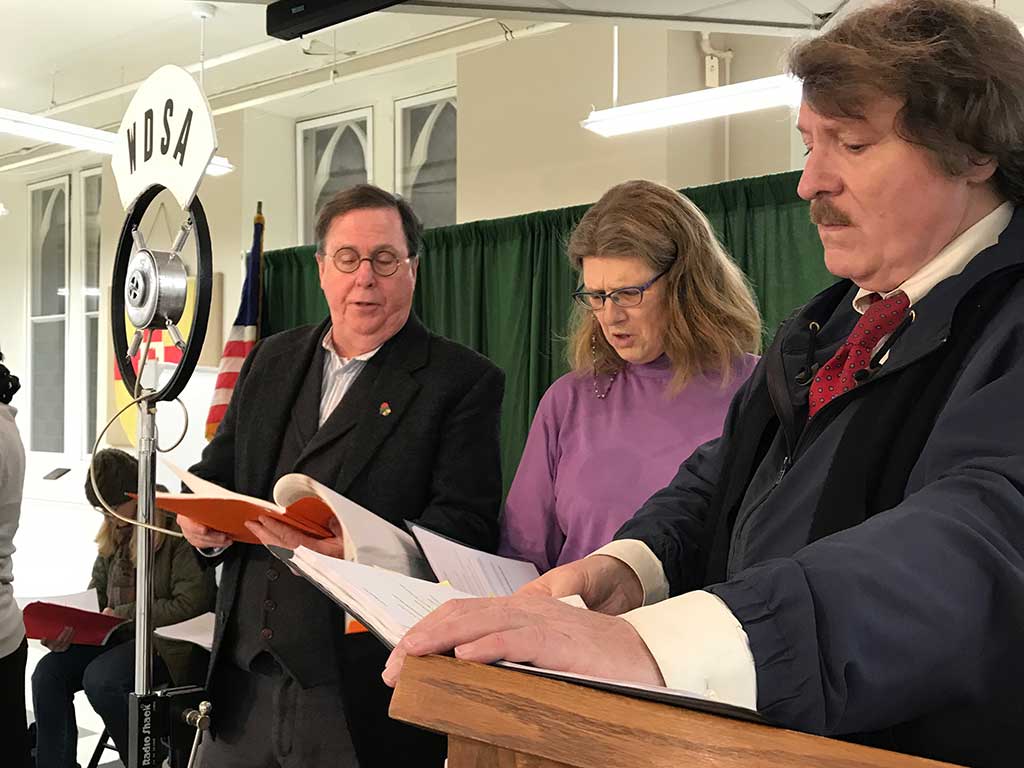
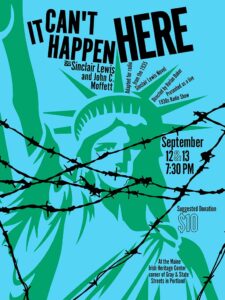
“It Can’t Happen Here,” is a play by Sinclair Lewis and John Moffit, based on a novel by Lewis. Local actors and director Harlan Baker will present the play on September 12th and 13th at the Maine Irish Heritage Center in Portland. Set in Vermont, where Lewis lived when he wrote the book in 1935, it describes a fascist takeover.
The simple production is accompanied with menacing realism by events around the United States, where National Guard troops stop vehicles in Washington, D.C., unidentified, masked authorities arrest people at courthouses and in the streets, universities cough up millions, and corporations give away shares to the federal government. Lackeys replace competent government employees.
“It can happen here. It is happening here,” said Seth Berner, who plays a farmer named Mr. Veder in the play. Veder and his wife begin by supporting Windrip, an aspiring dictator, and end beggared by the confiscation of their farm.
Familiar Territory
In 2018, Baker directed this play on the anniversary of Donald Trump’s first inauguration. Many of his actors wanted him to direct it again. He first read the book in 1983. Even then, “I was struck by how real the situation is.” In the book and play, Adelaide Tarr Gimmitch deplores women’s suffrage – and in the news of the 1980s, Phyllis Shafly did too.
In the 1930s, Ku Klux Klan racists, the Silver Shirts, antisemites inspired by Hitler’s rise to power, and Father Charles Coughlin spoke for fascism, as Proud Boys and Bugaloo Boys do now, Baker said.
Kelley McDaniel will read the part of Frances Tasbrough, played here as the widow of the original version’s factory owner, Frank Tasbrough, who begins with enthusiastic support of Windrip and ends up poor.
“I think the attacks on the press are particularly chilling. It’s without a free press that atrocities are allowed to happen because they are kept secret,” McDaniel said. She mentioned a recent New York Times report about a housing development in Arkansas’ Ozark Mountains where applicants are asked to prove they are white and straight. “I’m glad we have an independent media that can report on a story like that.”
Uniquely American
Doremus Jessup, played by Herb Adams, is a main character and a smalltown newspaper editor whose voice is silenced.
According to Adams, “Though 90 years old, [the play] could not be more amazing and timely – Windrip rules by ‘Corpo’ thugs, builds ‘walls’, rounds up dissidents, opens concentration camps, plans attacks on Mexico and Canada, [and] shuts down the press – all a little too familiar.”
Barney McClelland plays Dan Wilgus, the print shop foreman whose initial objections to composing print for a fiery opposition editorial fade before the urgency of the situation.
“People think fascism will always look the same, but Lewis showed us a uniquely American version of it,” McClelland said. He referenced a phrase famously associated with Lewis’ book though it is not an exact quote. “When fascism comes to America, it will be wrapped in a flag and carrying a cross.”
“The play describes how people can pretend it’s not happening,” McClelland said, at least until “neighbors start to disappear.” McClelland lived in Northern Ireland in the 1970s, during the Troubles, with a “front row seat” to its violence. “We are susceptible to the same follies.”
From Book to WPA Theater Project
Sinclair Lewis, the first American to win the Nobel Prize for literature, based his Windrip character on Huey Long. Long was a Louisianan politician on the road to a 1936 presidential campaign. He was assassinated in 1935, just before Lewis’ book was published.
In the Depression era of the 1930s, the Works Progress Administration (WPA) Federal Theater Project, headed by Hallie Flanagan, performed the play around the country. “Free, uncensored, adult theater” was President Franklin Roosevelt’s promise for this program. Flanagan asked Lewis to adapt his novel for the stage.
On October 27th, 1936, the play was performed in 21 theaters in 18 states in English, and in Spanish and Yiddish, and at an all-black production in Seattle, according to John Apicella, an actor and writer, from a YouTube report. By 1939, Roosevelt’s opponents in the United States Congress cut funding for the Federal Theater Project funding and the program ended.
Lorinda Pike is the “Society Editor” on the Vermont newspaper at the center of this play. “The Corpos intend everything,” she says, “They tell the industrialists they’ll stop all strikes. They tell the workers unions will be sacred. They tell the well-to-do they’ll have lower taxes; they tell the poor they’ll have twenty-five hundred a year.”
All that is echoed now, except the the last point. The poor nowadays are promised nothing.