We’re All in This Together
Climate Movement Must Flex Political Muscle in 2026
By Peter Dugas
The data is clear: Climate change is a growing concern for an increasing number of Americans. But if we’re going to correct our current trajectory and stabilize the climate, the climate movement must discover its untapped political potential, mobilize a growing climate concerned electorate, and advocate for robust climate policy at the highest levels. Let this be our New Year’s Resolution for 2026!
Although Americans are worried, most fall into the trap of thinking exclusively about personal action. We fail to grasp the need for policy solutions that can drive systemic change, or even to imagine that such policies might exist.
This is not an accident. It is the result of a well-funded, decades-long effort by the fossil fuel industry and its allies, who spend billions funding misinformation campaigns that employ sophisticated behavioral science techniques to trick us into thinking there are no policy solutions for climate beyond personal action.
Lessons from the Data
Recent research by the Environmental Voter Project (EVP), a non-partisan non-profit organization dedicated to mobilizing environmentalists to be more consistent voters, shows both great potential for increasing climate-conscious voting and critical lessons for refocusing our climate priorities.
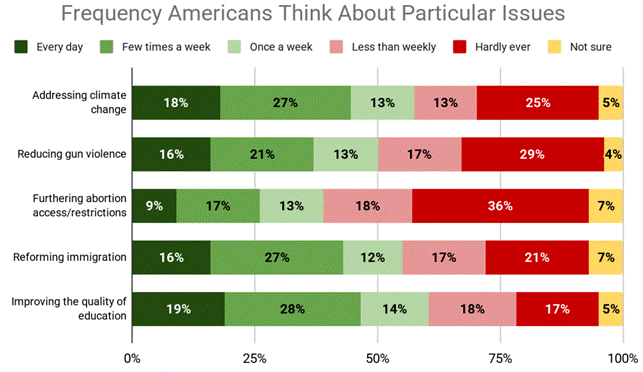
EVP’s recent research shows that contrary to the dominant narrative, climate change ranks high on respondents’ concerns, second only to quality of education in how frequently respondents say they think about it. Notably, it ranks higher than issues that get a lot more political coverage like immigration and abortion.
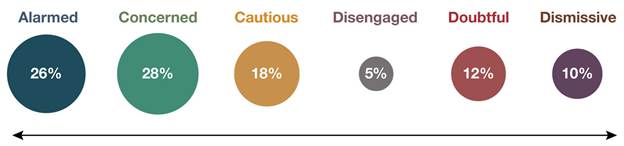
This is consistent with Yale Climate Communications Research. They show that most Americans (54% up from 47% 10 years ago) say that they are either “alarmed” (convinced global warming is happening, human-caused, an urgent threat, and they strongly support climate policies) or “concerned” (think human-caused global warming is happening, is a serious threat, and support climate policies) about climate change.
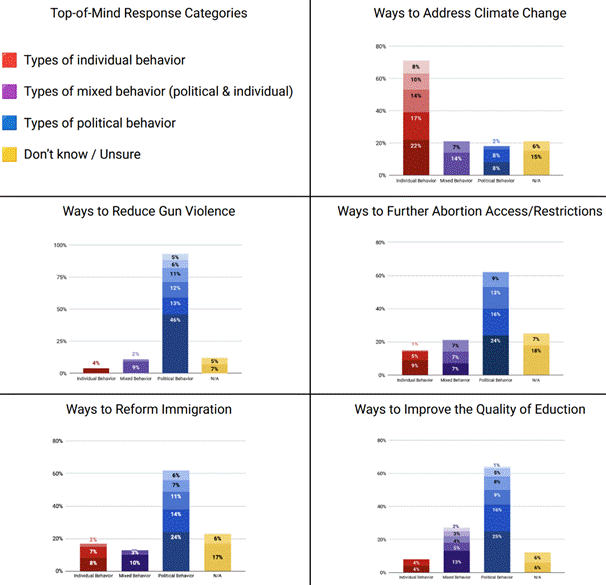
As encouraging as it may be to learn that climate change is growing as a public concern, when EVP researched opinions on what should be done about climate change, they found that climate change uniquely elicited responses focused on personal action at the almost total expense of systemic policy solutions.
The graph below shows responses citing personal action in red and policy-centered responses in blue, with combinations in purple.
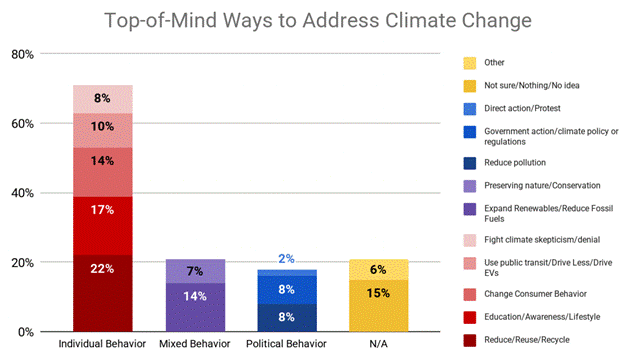
Frustratingly, the top answer respondents gave when asked what they thought could be done about climate change is “recycle” (22%). This personal action may be important but does little to reduce fossil fuel consumption and the associated greenhouse gas pollution.
The second and third most popular answers were also personal actions. Namely, “lifestyle changes and education” (17%) and “change consumer behavior” (14%).
Uniqueness of Climate Change
Comparing these lopsided results with responses on other issues (immigration, gun violence, abortion, and education), we see there that the vast majority of responses emphasized policy changes. This shows just how unique climate change is as an issue bereft of substantive policy discussion.
Again, this is no accident. Personal action does not address the systemic market failure that perpetuates consumption of climate-altering fossil fuel products.
Even the term “carbon footprint,” a term adopted by environmentalists and climate advocates, was coined by fossil fuel industry. They sought to shift blame from polluting industries onto individuals, as explained by Harvard scholar Naomi Oreskes.
We are all recipients of a messaging campaign promising that personal action is the only climate action available – or even imaginable!
Nothing could be further from the truth.
Climate change is a result of a market failure, and we can correct market failures.
Our global economy has stubbornly remained powered by fossil fuel energy. Decades after scientists coalesced to warn us that the resulting pollution threatened our future this remains true.
We can now see the end of fossil fuel energy dominance. Global renewable energy costs are falling faster than even the biggest booster in the industry would have thought just a decade ago. (Thanks largely to long-term policies from China and Europe).
Like a wounded animal, the fossil fuel industry is desperate and dangerous. It is doing all it can to retain market share and suppress renewable energy – aligning with anti-democratic forces to preserve profits, derailing effective systemic policies (like carbon pricing, a uniquely effective climate policy), and avoiding accountability for its role in the global climate crisis.
So, let’s make 2026 the year we counter misinformation and misdirection campaigns and work for systemic solutions.
Aggregate your powerful voices and be heard:
- Join Citizens Climate Lobby and move lawmakers of all parties towards bolder climate solutions.
- Get involved with the Environmental Voter Project’s canvassing, writing, and calling campaigns to make consistent voters out of hesitant environmentalists.
- Gather endorsements from community, business, and faith leaders through cclusa.org/endorse.
- Talk to friends and neighbors and ask them to send quick and easy messages to policymakers through cclusa.org/write-cfd.
Never forget: In the face of this global threat, we have both urgency and agency. Now let’s get to work and build the political will for a livable future.