Book Short
The Correspondent
By Virginia Evans
By Stephanie Miller
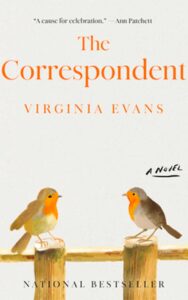
I’m not entirely sure why I enjoyed “The Correspondent” by Virgina Evans, my first exposure to her work (Thank goodness for book clubs!). Perhaps because I love novels that reflect on our complicated, messy, and ordinary choices in life. Perhaps because I love words, and a novel of letters is really about craft as much as story. Or perhaps, it’s just the kind of novel that is pleasant to read, but then you can’t stop thinking about it after you close the last page.
“The Correspondent” is a poignant, funny, and engaging story told in epistolary format with a memorable protagonist: retired Sybil Van Antwerp, who re-examines her life through letters and emails.
Sybil is a complex and often prickly septuagenarian. Two or three mornings a week at 10 a.m. she sits down to write letters, continuing a life-long habit that has been her primary way of engaging and understanding the world.
She writes to her best friend, brother, children, celebrities, and authors of the books she enjoys. Instead of phoning or texting, she writes notes to her next door neighbor (who turns out to be my favorite character) – a kind widow who is obviously in love with her.
But are these wonderful letters a shield she hides behind? A replacement for human closeness?
We enter her correspondence at a time when reflecting on her past and finding forgiveness is a central theme.
Despite the wisdom of age, she expects that life will continue as it always has. She’s been an accomplished lawyer, active community member, a mother, divorcee, and sister. She is incredibly kind and nurturing to some people in her life. However, when events force her to face the most difficult parts of her past, she is thrown off course.
First, she fights back, a tactic she used often in her life to mixed success. Finally, she accepts that a letter she has been writing for 40 years needs to conclude by coming into the light. In an inspiring twist, when she finally asks for forgiveness, there are many people in her life willing – even eager – to give it.
One enduring job of (most) literature is to give us hope and happy endings. Sybil’s letters are not always cheery, but they are strong and courageous. She advocates for herself and for her right to live as she chooses.
Also, Sybil gives us a tour through some wonderful literary adventures, as she writes to authors about how their books touched or annoyed her. She shows us that slowing down and taking time to carefully handwrite a letter by thinking out every sentence has real merit in our technically fast, 24-hour news cycle-driven world.
Micro Shorts
“Book Club for Troublesome Women“
By Marie Bostwick
Margaret Ryan creates a book club to get to know her fascinating new neighbor Charlotte Gustafson, who agrees to join only if they read the new controversial bestseller, “The Feminine Mystique.” Four suburban housewives bond over strong cocktails, secrets, their husbands’ bad habits, and their dreams to “have it all.”
This is a feel-good story celebrating the many strides that American women in the 1960s made toward equality, fighting for a chance to be a working mom with something close to equal pay, and overcoming not being able to get the Pill or a bank account without their husband’s permission.
At the end of the day, they each fight for a different but valid view of personal contentment. The role that deep friendships play in reaching your dreams is a recurring theme, and I think what holds the story together, despite some pretty fantastical experiences that try to link these ordinary women to national events.
“America’s First Daughter“
By Stephanie Dray & Laura Kamoie
Here is a story of Patsy Jefferson to prove the maxim that behind every good man is an amazing woman.
Actually, she was the force behind two men – her father and her somewhat erratic husband. All while birthing nine children. I do that math and think, good Lord, she was running at least one household, a plantation, and a political dynasty while pregnant for nearly seven years and then breastfeeding for another three!
This is one determined and strong woman. She took on the enormous and rather lonely role of caring for her father as a young teenager with a promise given at her mother’s deathbed. From Paris to Monticello to the White House and back to the Virginia hills again, she managed his home, political social calendar, and his legacy through scandal, personal tragedy, and poverty.
Thomas Jefferson is a demanding and selfish father and taskmaster, but Patsy stays loyal, despite the personal sacrifices and a difficult marriage to a man, incidentally, that her father chose for her. This is an enjoyable historical fiction view of a fascinating woman who had a major influence on our nation’s early years from the shadow of her genius and complicated father.
“The Nine: The True Story of A Band of Women Who Survived The Worst of Nazi Germany“
By Gwen Strauss
Ms. Strauss follows the story of her great-aunt, Helene Podliasky, who, along with eight of her fellow prisoners at the Ravensbruck concentration camp, escaped during the death marches at the end of the war to the American front lines.
It’s nonfiction told with an engaging technique, where at various points of the escape, Strauss features the backstory of one of the women. The visuals created by her solid and unemotional language are vivid: Nine emaciated women weighing about 50 pounds each, with filthy hair, bodies, and fingernails, exhausted from lack of food and untreated sores and broken bones in their legs and feet, knock on the doors of village inns and farmhouses looking for food and shelter.
It’s the end of the war near the front – some German citizens are kind and generous and weary of war. Some offer minimal succor with disdain in an effort to look good to the encroaching Allies. Still some are cruel and dismissive. Strauss did extensive research and pieced together the story from diaries and published accounts, although many of the nine women worked hard to erase those years from their lives.
“Mona’s Eyes“
By Thomas Schlesser
Take a tour through the Louvre with an erudite art historian, “seeing” the artworks through detailed descriptions (photos are included in the pull-out book cover) and discussing their importance, allegories, and artist intention with a precocious 10-year-old Mona.
Afraid that Mona’s sudden, inexplicable temporary blindness episode will result in permanent vision loss, her grandfather decides that instead of taking her to a psychologist, he will expose her to amazing art. If she does lose her sight, she will have visual memories of beauty forever.
It’s a very clever concept and the art history is accessible, provocative, and fascinating. The fictional story folded around the art reviews is unfortunately stolid and bland, which may be partly due to the translation.
Schlesser is an international best-selling author and an art history professor in France, so I recommend reading it for the art tour and if you enjoy the story, too, that is a bonus.