
Book Short
Reviews by Stephanie Miller
A Woman of No Importance:
The Story of the American Spy Who Helped Win WW2
By Sonia Purnell
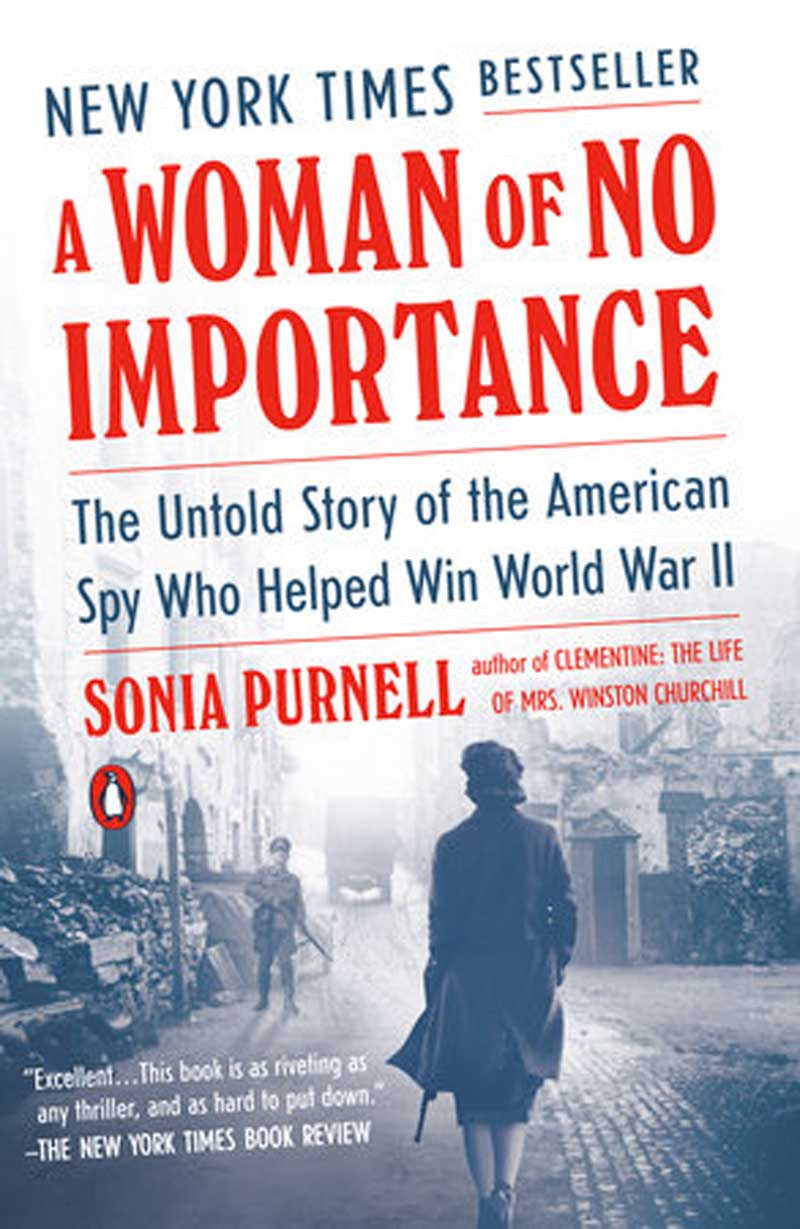
Disappointing her striving mother, socialite Virginia Hill abandons the family plan for her to marry well. Instead, she follows her adventurous heart to work in the fledgling intelligence unit of the state department.
However, in the 1930s, women were expected to look nice and act obedient and let the men earn the glory. Rejection after rejection for anything but clerical work did not deter her.
Losing half a leg in a hunting accident did not deter her, either. May 1940 found her doing the one front line job in Europe open to women: driving an ambulance.
Fluent in French and determined to prove the naysayers wrong, Private Virginia Hall traversed the roads of southern France as millions of refugees fled the Nazi invasion. They were literally dying along the roadsides by the thousands.
Thriving in the danger and prepared to take any risk, the war offered her the chance she craved. To find personal peace through active duty.
In a career that spins out from that heroic beginning, Hall became the most successful intelligence ringmaster of the French Resistance.
From the Resistance to the British Secret Service
This incredibly well-researched biography from Sonia Purnell follows Hall’s scrappy movement to work undercover with the nascent British Secret Service. She was literally the only covert operator who managed to organize successfully, communicate effectively with London, and keep new agents safe.
Of course, while the powers in London recognized her success, they just could not get over the fact that a mere woman could be a respected leader. So repeatedly they forced her to report to incompetent men.
The most danger she faced throughout the war was not from the Nazis but from her fellow agents. The men were not as serious about security nor capable of mastering the loneliness inherent in the job. While they philandered, squandered money, and put others at risk, Hall recruited a vast army of loyal supporter. She soldiered on despite her colleagues’ significant drag on her success and safety.
Not that the Germans weren’t trying to kill her, too. In 1942, the Gestapo sent out an urgent transmission, “She is the most dangerous of all allied spies. We must find and destroy her.”
The Limping Lady became an obsession of both the Gestapo and the Abwehr (secret service). Her story unfolds as one of continually escalating courage, danger, triumphant spy craft, stamina, and passion for liberty.
Very Readable Tribute to a Heroic Woman
The story of one of our most dedicated and resourceful heroines was almost erased from history because she happened to be female. Of course, much of the documentation of Hall’s life and activities were destroyed by herself as a security measure.
Purnell relates a memory from a wireless operator in London who was excited to meet this amazing field spy and felt close to her after thousands of decoded messages. She remembers Hall as gruff and unfriendly at the idea of being given a Medal of Honor. True to form, the best guerilla leaders do not leave a trail.
Published in 2020, this very readable history unveils the difficult and solitary undercover work done by Resistance fighters, and the many layers of bureaucracy that needed to be managed to get anything done.
In today’s world of drones, digital tracking, ubiquitous video cameras, and social media, it’s hard to imagine how blindly these agents operated.
A wonderful tribute to a heroic woman, this is also a celebration of all those who helped and supported — and gave their lives — in the fight for freedom.
Micro Shorts
“Heart the Lover”
By Lily King (MAINE AUTHOR)
Two genius literature scholars welcome a shy creative writing student into their circle. They nickname her Jordan after a character in “The Great Gatsby.” Thus begins a love triangle that is as life-defining as it is soul-crushing for all three.
A thread of frantic foreshadowing runs through this loosely held sequel to the author’s previous “Writers & Lovers” short stories, hinting in every chapter that something seminal and probably horrible is going to happen.
The novel paces solidly toward the dramatic and emotionally overloaded ending, where the three must reconcile those feverish early romantic days with the later life choices that separated them.
As a fan of King’s other works, I was really excited about this release, but despite some gorgeous language, clever games, and a few authentic characters, I found it a bit bland.
“American Wolf”
By Nate Blakeslee
The “most famous wolf in the world” – nicknamed O-Six by Yellowstone park rangers for the year of her birth — is the star of this nonfiction account of reintroducing the grey wolf to the northern Rockies.
Nearly extinguished during the early 20th Century by hunting, cattlemen protecting their herds, and federal policy, an effort by conservationists was made in 1985 to bring these majestic creatures back, creating a dramatic battle over the very soul of the West.
O-Six is my kind of alpha female. She descends from a line of strong matriarchs and creates her own pack by recruiting two brothers as her first followers. Then she teaches them how to hunt, and later births the pups and keeps them safe while teaching them how to survive. She fights off rival packs with some very strategic moves. And while she leads the full pack to dominance in Yellowstone’s breathtaking Lamar Valley, she still plays and romps and howls with pure primal joy.
With rangers and devoted wolf-watchers tracking her daily, O-Six and her pack become favorites of park visitors.
The novelistic book tells the story of wild animals who are both fierce and loving. But it does so without anthropomorphism them and reveals that time and again the wolves — while at the top of the food chain in the natural world — have a great and cruelly political predator in man.
Even if you don’t read the book, search YouTube for the National Geographic special called “She Wolf: The Yellowstone Legend.” It’s spellbinding and beautiful.
“Lazarus Man”
By Richard Price
An apartment building in Harlem blows up, and two days later a man is miraculously pulled alive from the rubble. He claims he can’t remember how he survived so much time while breathing in dust and debris. But he emerges convinced that he has been given a second chance from God.
Christened “Lazarus Man,” he speaks his new truth and rejects past mistakes. He preaches to others that disaster and grief can give way to new happiness.
Just as the collapsed building disrupts a quiet morning, so too this novel interrupts itself over and over. It skips between the characters’ stories as they intersect each other, challenging each to do exactly what Lazarus Man proclaims: Examine your life for opportunities to find joy.
If you can stay focused during this exhausting, rapid-fire pace, and keep up with the erratic revelations of all these different players, you will find yourself pleased — no, astonished — at the end. (Yep, that was a bit of foreshadowing for you.)
“The Sweet Dove Died”
By Barbara Pym
One of the author’s late novels, this 1977 slim volume is a poetic parable about the complexities of relationships and the extremes of human loneliness. This novel forces us to consider the bounds of devotion and loyalty.
Young James and his uncle Humphrey meet the elegant and self-absorbed Leonora Eyre at an antique auction. While both are attracted to her, she imprints on James as a part mother-part lover co-dependency. He is distracted for a while by first a disheveled young co-ed and then an artful playboy.
While Humprhey expects Leonora to turn away from James and toward him at any moment, the relationships don’t quite follow that expected pattern.
I felt both sad and encouraged at the way Leonora and James ended up and applaud Pym’s edgy treatment of what could have been a very rote and predictable turn of events.