
Book Short
33 Place Brugmann:
Where every resident has a survival story
By Stephanie Miller
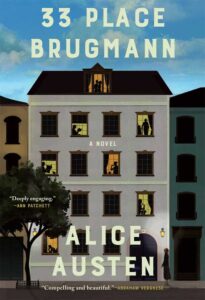
By Alice Austen
Grove Press
March 2025
pp. 368
It may be universally true that an apartment building full of people must also brim with stories of love, hate, good, and evil in some eclectic measure. It never struck me before reading Alice Austen’s wonderful “33 Place Brugmann” how the mix of a building’s residents tell the story of a time and place.
Set in the chaos of Nazi-occupied Belgium in 1939, Austen’s device of using one apartment building and the transformations of its tenants as representative of the turmoil throughout the country creates a brilliant and engaging novel. Past and present collide, along with rich personalities and a few mysteries worthy of the best spy novels. This tapestry of fear, collusion, resistance, and capitulation is so artfully woven that the characters seem close by — as if they were actual neighbors of my own.
When the Raphael’s of 4R disappear one night, they leave everything behind but their priceless art collection, which has vanished. Charlotte, an art student living with her architect father across the hall in 4L is hurt and confused by their midnight escape. Masha, a beautiful seamstress living in the attic apartment, falls in love with a calculating but dashing spy. He is friends with the retired Colonel in 3L who is more actively engaged in the battle than his genial manner and rather silly dog present to the world.
A father and son address the elephant in the room:
“We don’t talk about it. What’s happening.”
“We can’t.”
“Why on earth not?”
“We don’t need to talk about it. We’re in it.”
Despairing over the depravity of war, they cry. They laugh. They laugh with tears running down their faces. Finally, they hug. Living through this war, in this town, in this apartment building and beyond is exhausting and exhilarating and every moment is laced with filaments of fear. Every page of this novel brings that conflicting stew of emotional energy to the fore.
So much of WW2 literature is about the extraordinary daring of ordinary citizens and dutiful rank-and-file-rank soldiers. So is this novel. It’s also about choices among strangers and what neighbors will do to and for each other.
Micro Shorts
“The God of the Woods”
By Liz Moore
History repeats itself when another Van Laar child goes missing in the woods behind the Adirondack summer camp they own. As a panicked search begins, we are drawn into a multi-layered drama that unfolds hidden secrets of the Van Laar dynasty, a child missing thirteen years before, and the local neighborhood where, as the largest and most powerful employer, the Van Laar family pays people to be loyal.
Told in alternate chapters through the lens of the many characters living through three decades together, the reader is given glimpses into tensions between the family and the community as a long history of inheritance, protection, and hidden deeds emerge. It’s both a character drama and a mystery story. I read it in one day at the beach and felt breathless at the end due to the fast pace and the rapid switching of time and perspective. In the very last paragraph of the book, the title is explained — a nimble literary device that I enjoyed very much.
“The Child in Time”
By Ian McEwan
As many will recall from reading McEwan’s award winning tome, “Atonement,” he doesn’t shy away from complex characters dealing with complex emotions while struggling with complex relationships. When Stephen’s child Kate is snatched from him in the supermarket, he and his wife repeatedly replay the horrifying event and eventually must part from one another. Meanwhile, Stephen’s friend Charles, a Parliamentarian and respected statesman, begins to revert back to a childlike state. Stephen’s loss is magnified, and his anger stirred, as he tries to grapple with his friend’s behavior that seems to diminish his own loss. We are left wondering how much of life is fate and how much is choice. I would not say this is a pleasant story, but it’s very powerful.
“The Boxcar Librarian”
By Brianna Labuskes
Three stories hitch to each other like train cars in this historical novel based on true life Works Progress Administration (WPA) librarians, editors, and journalists who were employed to create the American Guide series, a set of travel books intended to put the nation’s destitute writers to work. (Side note: What a great idea!)
One story belongs to WPA editor Millie Lang who finds herself shipped off to Montana after standing up to a lecherous Senator. Another story belongs to the Guide team in Missoula who are clearly harboring a secret so meaningful it makes sabotaging their own success worthwhile. Throughout is woven the amazing and mysterious story of Alice and Colette who went out on the inaugural journey of the Boxcar Library, a converted mining train that brought books to isolated rural towns across the state.
This book is wonderful on so many levels: The tapestry of the overlapping stories, the history of the Guides, the landscape of early 20th century Montana, and a perfectly executed mystery. It inspired me to buy a copy of the Maine guide on eBay — and what a treasure it is.
“Find Me in Florence”
By Jule Selbo (MAINE AUTHOR)
Imagine if a very erudite, interesting, artistic, and well-connected friend goes to Florence and tells you a love story about the city and how it changes her life. Selbo has created a delightful romance set in one of the most romantic and beautiful cities in the world. I discovered so much about one of my favorite European cities, and also really enjoyed the fast-paced, light-hearted romance.
“The Life of Chuck,” a story in the collection
“If it Bleeds”
By Stephen King (MAINE AUTHOR)
Okay, yes — the advance previews of the dance scene grabbed me, too. As I do, I don’t bother to see the movie, I just read the book. This collection of King’s trademark weird (and one is squarely in the shiver-worthy horror genre) stories is worth it for more than the original language and fascinating, clever, and poetry-inspired construct of “The Life of Chuck.” The lead story in the collection, “Mr. Harrigan’s Phone” is also adroitly designed, with just enough fantasy that it seems it might actually, really could happen.