
By Nancy English
“Music is the universal language of mankind.” -Henry W. Longfellow
The website of New Horizons International Music Association, an international organization embracing the Southern Maine New Horizons Band chapter now based at the Portland Conservatory of Music, says, “Music provides opportunities for deep contemplation, a way of experiencing a broad range of emotions including serious thoughts or joyful moments.”
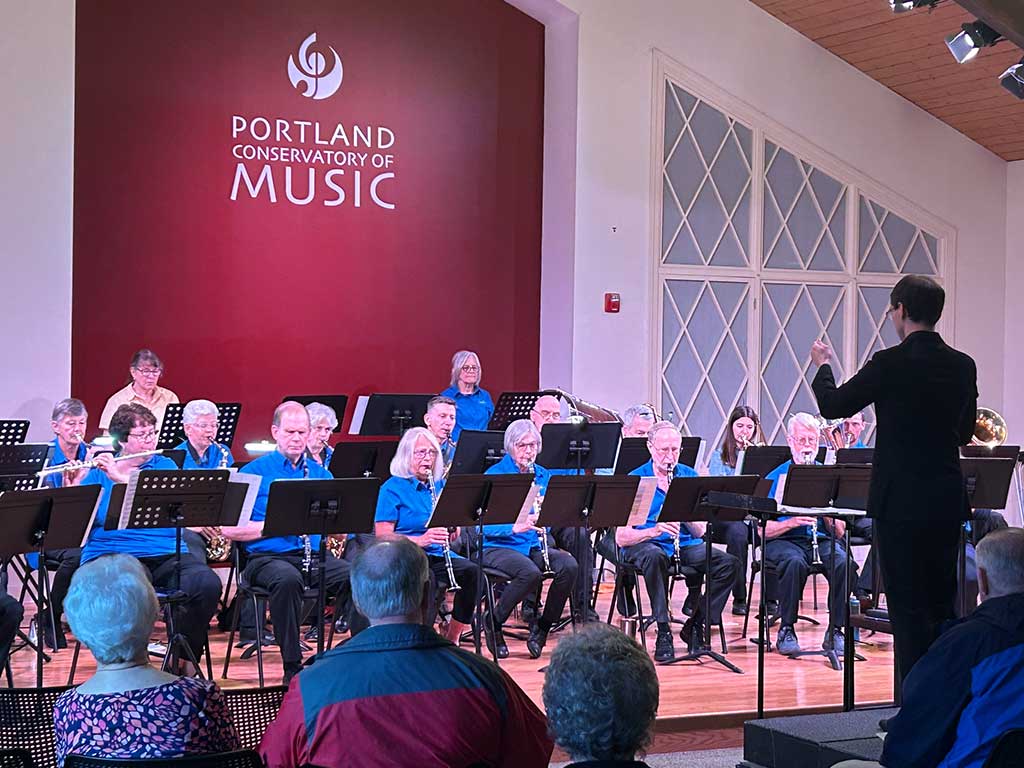
Courage
The organization, founded in the 1990s, started with the idea that adults want to play music together and flourish when they do. There is no audition to join.
Southern Maine New Horizons Band Conductor Michael Lund Ziegler, 39, who is also the Executive Director of Portland Conservatory of Music, said the conservatory motto is that “Everyone is a musician.” And, what’s more, “Music activates more regions to the brain than any other activity.”
Among the 28 people who participate in the Southern Maine New Horizons Band a common virtue is courage, he said. “Sometimes it needs to be unearthed.”
Many start playing with New Horizons having played an instrument in their distant past. But some, like Steve Graef, 70, who started three years ago, had no experience playing the instrument they took up. In his case, the trombone.
“Gradually I became able to get the right notes and keep up with the rest of the band,” he said. “I master some of the easy parts.” He said playing the trombone has always been fun.
The band members play a concert at the end of each of three annual sessions. They pay $150 fee per session, though “the policy is that finances will not be a barrier,” Ziegler said. The musicians attend 4:15 rehearsals in the space below the Fellowship Hall at St. Luke’s Cathedral.
‘Michael has pushed us to do more.’
Ziegler, with 20 years conducting, has been the band’s conductor for a year. He most recently led the band in Gustave Holst’s First Suite in E-flat for Military Band. Robert Pantel, 76, who since 2027 has played the tuba in the band, said he was moved while performing the piece by how beautiful it sounded.
That composition was challenging, and the challenge was rewarding, Pantel said. But, “It’s a supportive environment rather than a competitive one.” He encourages folks, if they have any inclination at all, to sit in a rehearsal and see how it feels. He also said that the majority of the members of the band are older, but some are younger too.
Often, the participants who played an instrument in their past may still have it sitting in their closet. Jim Belanger, 62, played the clarinet in his youth. He grew up in Westbrook, which had a wonderful music program. But when Ziegler asked if he would take up the tenor sax, Belanger was game.
“The clarinets and the flutes are the high voice and play the melody,” he said, but the tuba, baritones, trombones, and tenor sax play the bass notes.” Ziegler wrote a five- or six-bar section into a recent piece for tenor sax that Belanger played. He feels especially rewarded during rehearsals, he said, which are “more fun than anything.”
“But,” he said, “There are a good amount of people who started playing in New Horizons.” Some, like Graef, filled a need in the ensemble, which now has a much larger brass section. But all are welcome who wish to join.
Both Belanger and Pantel praised Ziegler’s conducting, from keeping all in time and cueing musicians at the right moment for their parts, to sustaining their enthusiasm with more challenging music.
“’Your best is good enough,’” Pantel said, quoting the founder Dr. Roy Ernst, “yet Michael has pushed us to do more.”
Reward
“Every person in an ensemble is an integral part of it,” Ziegler said. “When music is well written, every part matters.” He prides himself on having a good knowledge of players’ skills and personalities, and on choosing music that works best for them.
He said he has taught everything but is no expert. On occasion an expert will provide instruction, like a percussionist who helped players with orchestra drums, tympany, vibraharp, and more to hone their skills. “Percussion is quite diverse.”
Ziegler’s had his own musical epiphany while singing a 9-minute Estonian composition in 2006 at an Omaha Nebraska Choral Convention, when he was in the choir at Lawrence University.
“Raucous applause and a standing ovation came in the middle of a set,” he said, as the realization set in that something extraordinary had been accomplished, “a moment that lived with me. Those experiences show us the incredible things we are capable of.”
“When we are young everything is new,” he said. Perhaps it is easier then to take up an instrument. But musicians coming back to instruments or starting to play have a level of humility, and set aside egos, and they are willing to become good again.
“The reward is incredible.”