Book Short
Beyond that, the Sea
By Laura Spence-Ash
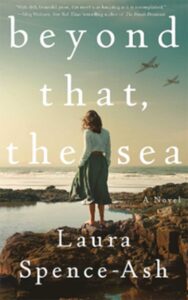
By Laura Spence-Ash
Celadon Books (May 2024) – pp. 368
It’s 1940 and bombs are falling on London. To keep eleven-year-old Bea Thompson safe, her working-class parents send her across the sea to America. She is met at the docks by the Gregory family, who fold her into their affluent lifestyle. All fall in love with this plucky, intelligent girl who seems to fill the empty spaces in their family.
Spending summers on the Maine coast, Bea’s life in America begins to feel natural. She starts to make plans for post-high school along with the two Gregory boys whose ages bracket hers. However, when the war ends she abandons those plans and dutifully returns to England. It’s a place that she barely remembers and has dramatically changed from the war. There seems to be nothing left of her childhood.
Something is different about Bea’s experience.
Other children who were sent abroad or to northern farms settle back into their family life without a stammer. She finds it difficult to reconcile these two worlds of her childhood, both filled with love but vastly different. Her yearning over missed experiences and the jealousy inevitable between the two sets of parents create competing gravitational pulls that remain in her life long after she returns home.
Bea remains unsettled. Half her heart is back in America and half is trying to find a place for herself in post-war London. A chance meeting as the older Gregory son travels through England reminds her of all she has lost and she begins to question her adult choices.
And thus the real story begins…
As Bea and the Gregory brothers become their adult selves, all three realize that the connections between them cannot be severed by time or distance… Or even purposeful snipping of memory. In fact, unbeknownst to Bea, her two sets of parents create connections as well, sending trans-Atlantic letters that share the pains of parenting and personal struggle.
Told via alternating voices of each member of her two families, the story rushes forward and then is caught back with a memory of the same experience from a different person. Throughout, and despite (or because of?) the abundant love all around, Bea is striving – striving to fit in with a new, strange family, for peacefulness, for the comfort of connection she knew with the Gregory’s during the war, for belonging.
Any story of love where the Maine coast has a role is always going to appeal to me. This debut novel is luscious in tone and packed with beautiful language.
July Micro Shorts
“The Road to Dalton”
By Shannon Bowring (Maine Author)
A car crash on an icy road in far northern Maine kicks off a haunting and very human story of the residents of fictional Dalton in the real Aroostook County. The shock of the crash moves newlywed Bridget into early labor, while Richard and Trudy–who agree to stay in their marriage despite not being what the other needs–desperately try to calm her. The blood stain in the back of their car never really comes out.
I think that stain is a metaphor for the unspooling of the story, where good people in a very small community both stand up for each other and stare down anything out of the ordinary. I fell in love with this town and these flawed but hopeful people, including the young ones longing to escape and the adults who have settled in to make the best of it.
Lots of awful things happen, but lots of hope and love remain. Luckily, this is only the first of a series – and the second, “Where the Forest Meets the River,” continues the story of how the birth of Bridget’s child continues to stain and impact the people of Dalton five years on. Both showcase the authors’ gentle, warm, and wise storytelling and beautiful prose.
“Mrs. Nixon: A Novelist Imagines a Life“
By Ann Beattie
This is a life philosophy book disguised as fiction. I have a long fascination and interest in Pat Nixon because my mother always viewed her as a heroine with strong philanthropic interests and a moral core. I read her autobiography years ago, and picked up this novel with great expectations. It’s not what I expected, but that isn’t necessarily bad.
Beattie uses Nixon’s life and the mores of the times she lived in as a springboard to discuss feminism, motherhood, political life, and of course, since this is about the Nixons, stoicism in the face of deceit (and defeat, as it worked out). Essentially, Beattie uses Pat Nixon as a kind of flawed and unknowable “Everywoman.”
I found much of it striking. Especially the parts about how we tell ourselves stories and myths to elevate our moral choices. Which happens in every facet of society, not just politics. I also found it slow. Perhaps others will see what I found to be ponderous, pretentious, and repetitive as amusing or sardonic. Beattie even breaks the third wall, and gives herself (the author) a place in the story.
“Curious Toys“
By Elizabeth Hand
A dark serial-murder mystery set in the heat of Chicago 1915, where someone is smothering young girls at the amusement park. Unflinching from the vagaries of that era, the newspapers make up headlines, the police are corrupt, and the park owner capitalizes on the murders to separate even more people from their scant, hard-earned cash. (“Someone always makes a profit over a tragedy,” the police chief laments – sad because he won’t be the one benefiting!)
Her mother insists that fourteen-year-old Pin dress like a boy to “stay safe.” But Pin is secretly glad to be out of uncomfortable, binding dresses and free to run, earn money, flirt with girls, and explore the world behind the Park’s magic – all set up to fool the “rubes.”
Two years ago, Pin’s younger sister was lured away and killed. Just another forsaken slum girl gone and forgotten in the busy, pulsing, harsh city. Now she has a personal interest in finding the killer.
Told in alternate characters, it can take a few paragraphs in each chapter to identify the speaker. One of the storytellers is the murderer. You don’t know which until the end, and even now, I’m not sure how much of the story is actually in the murderer’s voice!
It’s a wonderful period piece written on a big canvas that captures the heat, the dirt, the class system, the hopes and dreams, and the emerging technology of the day. I loved Pin as a character, although the book is a bit thin on development, relying on events to carry the story along. Despite the dark themes, this is a good beach read.
“We Are All Welcome Here“
By Elizabeth Berg
Based on a true story, Diana Dunn has the dubious fame of being the only living child born of a polio patient living in an iron lung. She loves her mother Paige fiercely, learning and playing and being disciplined only by her mother’s voice. She often forgets that voice is the only way her quadrapedic mother can show her anything.
Now fourteen, Diana is starting to rebel against her unusual family, and loves and hates her proud, capable, courageous mother in alternating measure. They are poor and a bit ostracized by the town, but amazingly happy and capable. Spoiler alert: Elvis himself actually saves the day.
Like all Berg fiction, this is told in a rolling, gentle movement, capturing both Diana’s growing pains as well as the painful realities of life in 1964 Mississippi. At one point, in response to her social worker’s careless comment, the indomitable Paige rages, “We are ALL trapped. We are all trapped in a body with limitations, even the most able bodied among us! And we’re all guided by minds with limitations of their own. You want to know my philosophy? It’s this: Our job, regardless of our bodily circumstances, is to rise above what holds us down, and help others do the same.”