Book Short
The Calamity Club
By Kathryn Stockett
By Stephanie Miller
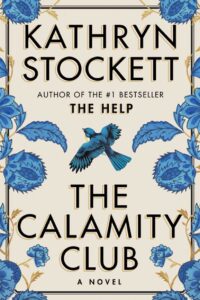
I started skeptical – how could Kathryn Stockett possibly keep me engaged for this huge 650- page novel? Twenty page turns later I was intrigued, but pretty sure the story would drag. Another few chapters and I stopped thinking and just immersed myself in this delightfully witty, clever, and sensitive novel of life on the edge of solvency in the height of the depression along the Mississippi Delta.
Strong Female Characters, Rapid Pace, Lip-bitingly Funny
The cover synopsis doesn’t reveal much about the story which leaves us open to discovery — and no spoilers here, either. There’s Birdie, the older, competent, less pretty sister who has humbled herself to ask her snooty, married-for-money sister for a loan to keep their family afloat. There’s Meg, the feisty, smart, eleven-year-old orphan who is abused by the asylum matron for reasons she cannot comprehend, but, as they emerge, are central to the plot.
Also, there’s a prologue where Birdie buys a hundred condoms, but you don’t really know why. (I confess I forgot about the prologue. After all, the events it foreshadowed don’t occur until the final third of the book. And then, I got my satisfying a-ha moment.)
Like Stockett’s first best-selling novel, “The Help,” this is a story of strong female characters operating intentionally but somewhat desperately in a world of blatant misogyny and horrifying racism. It’s also about the stories we each tell ourselves to look confidently in the mirror in the morning.
Dialogue – and inner dialogue – keeps the pace rapid and lip-bitingly funny. Chapters in orphan Meg’s voice don’t use quotation marks. Spoken words are in italics. It’s a nice literary trick that gives the impression that every word is being processed through Meg’s teenaged lens, which is nonetheless as sharp and savvy as the typical literary orphan.
There is no big seminal moment or personal transformation. The characters stay themselves and respond to situations authentically and consistently.
So why is this book so good?!
Perhaps because it is wonderfully entertaining. The characters – even the distasteful ones – are boldly drawn and realistic. The story feels like it really could happen this way. I felt a secret glee that an audacious caper like this was actually pulled off under the noses of the society snobs and the sheriff. The one (very satisfying) comeuppance scene is not overdone, and there is no saccharine epilogue of happily ever afters.
Instead, it’s a story of an unlikely cohort of women doing something extremely bold, possibly brilliant, and most probably stupid, in order to stand up, get by, save themselves and their families, let themselves fall in love, be kind to children, and extend the hand of friendship.
Micro Shorts
‘An Inconvenient Widow, The Torment, Trial & Triumph of Mary Todd Lincoln‘
By Lois Romano
The subtitle says it all, “The Torment, Trial & Triumph of Mary Todd Lincoln.” This is a very readable and sympathetic nonfiction account of Mrs. Lincoln’s life in a socio-political fishbowl. While she may be the most mocked first lady of all time – she’s an easy target, perhaps – she also set an elevated tone for gracious hosting at the White House. And her work to lobby Congress for a First Lady’s pension benefited every Presidential wife alive at the time and since.
Uncommonly politically sophisticated, she was among her husband’s political confidantes on his winding path to the White House. The country was on the brink of dissolution when he took office. As such, she faced expectations and pressures far greater than those of her predecessors.
“She buried three sons and her husband was killed in front of her. She then lived as a terrified, sad, lonely widow, trying to survive, fighting for her freedom, dignity, money and her rights,” Romano writes. “She did this under a magnifying glass, rarely given the benefit of the doubt, rarely receiving empathy or kindness in her own country. [Her] missteps and frailties – not her goodness of heart and patriotism – are remembered, leaving us with a caricature, rather than a balanced portrait of her failures and accomplishments.”
She was a larger than life character. People complained that she spent too freely, grieved too publicly and for too long, and seemed unable or unwilling to corral her emotions, temper, and opinions. The nastiness against Mary seemed never ending, often from those who had never met her. But she also helped feed the fire with indiscretions and poor decision-making.
One of the most influential people on her legacy was her own son, Robert, himself “so afraid of negative publicity that he distanced himself and maligned her privately and publicly. He did not try to protect her,” Romano writes.
“Abe was judged by the aggregate of his life and achievements, as was Robert, and Mary helped push them both to greatness,” the book claims. “It was a misfortune of the time and unfair that women like Mary would be judged through a singular prism.”
At Mary’s funeral, Rev James Reed is recorded as saying “It cannot be any disrespect to her memory to say that the bullet that sped its way and took her husband from earth took her too… they have virtually been killed at the same time. With the one that lingered, it was a slow death from the same cause.”
‘Sweet Water‘
By Christine Baker Kline (Part-time Maine Author)
Cassie’s living an artist’s life in Brooklyn when she learns her grandfather – a man she never knew – left her the family farm in Sweetwater, Tennessee. She takes it as a sign to move there and try to learn more about the family of her mother who died young in a strange accident that no one talks about. The Southern family is welcoming with false politeness. Cassie quickly finds that there are things this family just does not talk about. The story quickly turns into a rather predictable romance novel, but the rich characters and the way Baker Kline moves the story along via two narrators made this a good beach read.
‘An Elephant in the Garden‘
By Michael Morpurgo
This tween fiction is inspired by a true story. A zookeeper is devoted to saving the elephant when all the large predator animals must be shot to prevent them from attacking citizens if they are somehow freed when bombs start falling in Europe in WW2. Morpurgo sets this tale of escape and complex loyalty amid the destruction of Dresden, when thousands were forced to flee in the dead of winter. The young elephant, Marlene, becomes the touchstone for the family and those traveling with them, including a full class of schoolchildren, inspiring them to keep moving, stay calm, and support each other.
‘The Librarianist‘
By Patrick deWitt
This charming story is a coming-of-age novel in reverse. We meet career librarian Bob after he retires to a solitary life of books and quotidian comforts. A chance encounter leads him to volunteer at the local senior center. His good nature and quiet demeanor help him fit right in as the straight man to the characters he meets there. Through conversation and adventures with the center residents, we uncover his character and the story reveals his life’s seminal moments which have made him such a kind, compassionate man.
He forgives but never falls out of love with the ex-wife who runs away with his best friend. He meets a kind but weird set of “interesting friends” when he successfully runs away for four days at age fourteen —their empathy for a fellow outcast suits his sober, bookish personality. And a chance visit from a young, unsuccessful window salesman saves his life after a nasty fall. I closed the book wishing Bob a happy, quiet, contentment.
‘Delicate Edible Birds, and Other Stories‘
By Lauren Groff
Nine stories reveal drama and insight from the lives of modern American women. Some characters create personas that they toss aside through boredom or revenge. A few fruitlessly seek new adventure. One sacrifices her soul to save herself and three male fellow journalists trapped by Nazi sympathizers.
Like the best short stories, these are incandescent moments in time that are both satisfying themselves and give rise to imagining a larger world around the characters. Groff’s spare but pressing prose is similar to the character-driven forces we all loved in her successful “Fates and Furies,” showing she’s a master of both novels and stories.
‘So Far Gone‘
By Jess Walter
Living off the grid for five years after a disastrous family Thanksgiving with his conspiracy-theory son in law, Rhys Kinnick is suddenly drawn back into the larger world after a dozen years. This occurs when his daughter goes missing and his two teen-aged grandchildren show up on his doorstep. With his outdated experience and a car that barely runs, Rhys moves from one bad decision to another. Despite all the horrible things that happen, somehow this is also a very funny, poignant, and loving tale. It’s part mystery and part humor and part commentary on our fractured, divided country.
‘The Reading List‘
By Sara Nisha Adams
I reviewed “Twilight Garden,” Adam’s second novel, last month, and promised to find this one. Her first and most successful. Here, a grieving widower tries to bond with his bookworm granddaughter by going with her to the library.
A reading list headed, “Just in case you need it,” has been found among the shelves. So, he starts to read them in order on the recommendation of a teen-aged summer librarian, who uses the list to mask her own lack of literary knowledge.
I’m sure you can write this script as I did. In a series of heartstring-pulling chapters, novels rescue people — including the protagonist. The actual reading list is good and includes a number of my personal favorites, but I put this one in the cagey category of an author luring us book lovers in with a story that features books as heroes.