

Todd Morse: Looking at Property Tax Evaluation
Every month, Liz Trice interviews a community member for The West End News. This June, she caught up with Todd Morse, founder of the Urbanist Coalition of Portland and data analyst.
The city updated the values of all the properties in the city. What does your data show?

When talking about trends in property taxes the most important thing to talk about is share of value. The City sets its budget and then it sets the tax rate to what it needs to cover that budget. What you pay is based on the percentage of the taxable property value in the City that you own. Property almost always goes up over time but that doesn’t necessarily change your tax bill. You see a shift in the tax burden when some properties get more valuable more quickly.
The overall change should be less than it was in the last assessment. While we do see shifts in value, they won’t be as extreme as they were in 2021. This makes sense because there has been less time between assessments.
The most obvious trend is a decrease in the share of value of offices and a smaller decrease in retail. This means that offices and retail spaces aren’t getting more valuable as quickly as other properties. This reflects genuine trends in Portland. There has been a shift away from in-office work which can also impact retail.
Single-family homes and condominiums saw their share of value increase, while mid-sized housing (2-5 units) saw roughly no change and larger housing saw a decline. It is less clear why this is. One potential explanation is that some newer rental buildings like the Casco and the Hiawatha have first-floor retail which classifies them as multi-use commercial rather than residential. It is possible that new construction trends focusing on single-family homes, condominiums, and mixed-use buildings means these properties are newer overall and therefore more valuable. Though, more analysis is needed here.
Does the city have any control over which types of properties they tax more or less? Or is it purely the market?
The city has very limited control over how we can assess. For homes, assessments are based on comparable sales, and for revenue-generating properties like rental housing or commercial real-estate, assessments follow a formula that is heavily based on how much rent they can generate.
Maine State law and even the state constitution are quite specific in how assessment must be carried out.
Which types of properties will see the largest tax increases?
People who have built or renovated will always have by far the largest increases, but for existing properties single-family homes and condominiums will see the largest increases on average.
How did you get involved in this?
I have always been very interested in data and local issues and I would love to spread some more awareness about how property taxes work. The property tax system is complicated and I think when people get an assessment in the mail and see a number that is 40% higher they quite rightly feel afraid. I hope that I can add some context about what these numbers mean and how they fit into a larger picture.
Are there any ways that people should get involved in these issues?
On a personal level you are able to appeal your assessment if you feel it is unfair. It is too late to appeal this revaluation but they do happen regularly. So there will be opportunities in the future.
On a policy level, and this is my personal opinion, I feel property taxes show us that we are in this together as a city. If our commercial properties aren’t thriving or we aren’t building enough housing, we all pay for that in our tax bills or in higher rents. Anything we can do to support a vibrant city with enough housing can help make a difference.
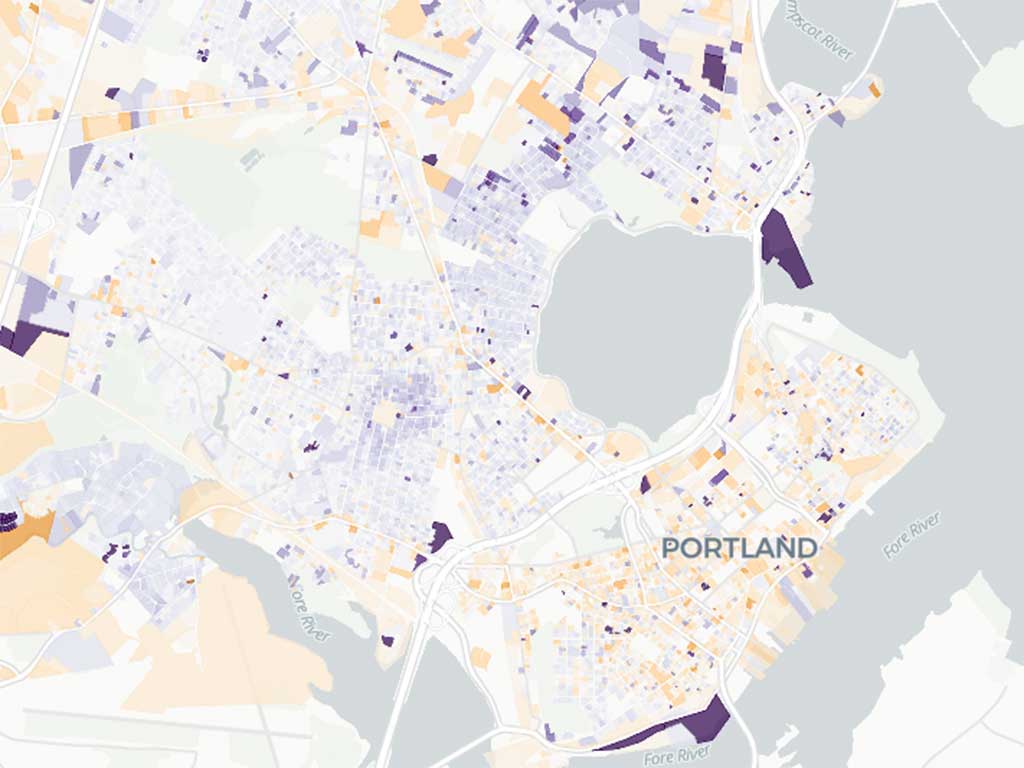
Map: Change in Share of Taxable Value (2024-2025)
To learn more about UCP’s work analyzing the city property tax reevaluation and to view a map of the change in share of taxable value (with detail down to individual properties) visit:
https://www.urbanistportland.me/blog/sneak-peak-state-of-the-assessment-2025
This interview was edited for clarity and brevity.